


Wear solid, well-fitted clothing in a mid-tone or deep color, one step dressier than your everyday workwear, with a neckline that frames your face and almost no accessories. Bring two or three options so your photographer can choose what works with the lighting and backdrop. That covers most of it. The rest of this guide explains the reasoning, so you can adapt it to your industry, your skin tone and the purpose of the photo.
We produce photo and video for brands, corporate teams and events, so we see what works in front of a lens every week. Below you will find the practical version: what to pick, what to leave at home, and how to prepare so the shoot goes smoothly.
TL;DR
- Choose solid colors such as navy, charcoal, deep jewel tones or soft neutrals. Skip busy patterns, large logos and anything you have never tested on camera.
- Fit matters more than price. Clothing that is neither tight nor baggy photographs better than an expensive piece that pulls or bunches.
- Keep accessories minimal. The photo should lead the viewer to your eyes, not your jewelry.
- Dress one level above your daily norm, matched to your industry and the audience who will see the photo.
- Bring backups, steam or press everything, and ask your photographer or team lead what the backdrop will be.
Table of Contents
- Start with the purpose of the photo
- The best colors for headshots
- Patterns, textures and why solids win
- Fit, fabric and wrinkles
- Necklines, collars and sleeves
- What to wear by role and industry
- Accessories, glasses, hair and grooming
- What we recommend
- How to run a team headshot day
- A simple checklist for the night before
- Professional headshots for your team or brand
- FAQ
- Sources
Start with the purpose of the photo
Before you open your closet, decide where the headshot will live. A LinkedIn profile, a company website team page, a speaker bio for a conference and a press kit each carry slightly different expectations.
Career centers at universities give a useful baseline. Auburn’s engineering career office, for example, lists business professional dress as the standard for professional headshot photos, with suit colors such as charcoal, navy and black among its recommendations. That is a conservative standard written for students entering the workforce, and it is a safe starting point when you are unsure.
From there, ask yourself three questions:
- Who will look at this photo? Clients in finance or law usually expect a more traditional look than clients in design, tech or hospitality.
- What does the rest of your brand look like? If your company uses a navy and white palette, a navy jacket will sit comfortably next to your logo.
- Will it sit beside other headshots? If your team page shows twelve people, consistency matters. More on that below.
The best colors for headshots
Color is the question most people ask first, and the answer is less mysterious than it seems. You want a color that separates you from the background, flatters your skin and does not compete with your face.
Reliable choices
- Navy. It reads as credible and works on almost every skin tone and in almost every industry. It is the color we would put at the top of the list for a corporate headshot.
- Charcoal gray. A close second. It gives clean contrast against light and mid-tone backdrops.
- Deep jewel tones. Emerald, burgundy, teal and plum add personality without shouting. They are a good option if your industry is creative or you want to look approachable.
- Soft neutrals. Tan, taupe, cream and light gray can look refined, especially against a darker background.
Colors to handle carefully
- Black. It can look sharp, but black against a dark backdrop makes your head appear to float. On lighter skin, a black suit can also create more contrast than is flattering. Test it before committing.
- Pure white. It can wash out under strong lights and pull the eye away from your face.
- Neon and very bright colors. They can reflect onto your skin and look dated quickly.
The most useful trick is simple: hold the garment up near your face in daylight. If your skin looks brighter and healthier, keep it. If you look tired or sallow, swap it.
Patterns, textures and why solids win
Solid colors are the safest choice because nothing competes with your expression. Fine stripes, small checks and tight herringbone can also cause moiré, the shimmering, vibrating effect that digital sensors sometimes produce on tight repeating patterns.
If a plain top feels flat, add depth through texture instead. Knits, subtle weaves and structured fabrics give a garment visual interest without creating that shimmer. A fashion editor’s guide to professional headshot outfit ideas makes a related point: it is worth testing the actual outfit against the actual backdrop, or something close to it, before shoot day. A fitted blazer in a pale color, for example, can read very differently depending on what stands behind it.
Logos, slogans and graphic prints are best left out. They date the photo, they can clash with your company’s own branding, and they invite the viewer to read your chest instead of meeting your eyes.
Fit, fabric and wrinkles
Fit does more for a headshot than color or brand. Clothing that is too loose adds visual bulk, and clothing that is too tight pulls and wrinkles across the shoulders and chest, which the camera exaggerates.
A few practical checks:
- Try on your outfit and sit down in it. Look at the shoulders, the collar and the bunching around the arms. Headshots are usually taken from the chest up, so the shoulders and neckline matter most.
- Check the collar. A shirt that is too tight at the neck bulges when buttoned. One that is too loose gapes when you lean toward the camera.
- Steam or press everything the day before. Wrinkles that you barely notice in person show up in sharp detail on a high-resolution image.
- Choose fabrics that hold their shape. Heavy cotton, wool blends and structured knits usually do better than thin linen or silky materials that cling.
If one garment is almost right, a quick visit to a tailor is often worth it. A small adjustment to the sleeve or shoulder can be the difference between a good photo and a great one.
Necklines, collars and sleeves
Your neckline frames your face, so it deserves the same attention as color.
| Neckline | How it tends to photograph |
|---|---|
| Modest V-neck | Elongates the neck and draws attention to the face. A dependable choice. |
| Crew or boat neck | Clean and classic, works well under a blazer. |
| Open collar shirt | Relaxed but professional, good for approachable industries. |
| Turtleneck | Can shorten the neck visually. Test it first. |
| Very low neckline | Pulls attention away from your face and can leave you adjusting during the shoot. |
| Tight buttoned collar | Bulges around the neck if the shirt is too snug. |
For sleeves, long or three-quarter lengths usually look more finished. Photographers often turn you at an angle to the camera, which puts your arms forward in the frame. If you prefer sleeveless tops, bring a jacket or cardigan for at least part of the session.
Layers help in general. A jacket over a simple top gives you structure and lets you take two looks from one outfit by wearing it open, closed or off.
What to wear by role and industry
There is no single correct answer, which is why “dress one step above your daily norm” is a better rule than any fixed list.
For executives and client-facing roles
A tailored navy or charcoal suit or blazer with a crisp shirt is the safe, authoritative option. Ties are optional and depend on your industry. If you wear one, choose a solid or a very subtle texture. Women can pair a blazer with a simple blouse, a shell or a structured dress.
For sales, marketing and tech teams
A blazer over a quality knit, an open-collar shirt or a clean sweater often strikes the right balance. You want to look like the person a client would be happy to meet over coffee, not someone dressed for a gala.
For creative and consulting professionals
You have more room for color and texture. A jewel-tone top, a structured jacket or an unusual but tasteful collar can signal personality. Keep the rest of the outfit quiet.
For healthcare, education and service roles
Follow your organization’s guidelines if it has them, whether that means scrubs, a white coat or a branded polo. When there is no policy, solid business-casual pieces work well.
For women choosing between several options
If you are building a professional wardrobe and want help with outfit planning for women, interview outfits for women: what to wear and why covers how to put together looks that carry from the interview room to the camera.
Accessories, glasses, hair and grooming
The purpose of a headshot is eye contact with the viewer. Anything that pulls the eye elsewhere works against that goal.
- Jewelry. Keep it small and quiet. Studs, a thin chain or a simple watch usually work. A useful test: look in the mirror before you leave and remove one accessory.
- Glasses. Lens glare is the most common problem. If your lenses have an anti-reflective coating that casts blue or green tints, mention it to the photographer. Some people use frames without lenses for the shoot, which is worth discussing in advance. Angling the frames slightly downward can reduce glare, but a photographer with proper lighting control will solve it better than trial and error.
- Hair. Style it the way you wear it on a good day, and do not try something new for the first time on shoot day. If your hair is long, ask whether the photographer wants some of it forward over the shoulders to frame the face.
- Makeup and grooming. Keep it natural. Rutgers’ career center advises job seekers preparing for its portrait lounge to keep the look simple and avoid the temptation to overdo makeup. The same applies to facial hair: trim it the day before, not the morning of.
- Nails and hands. If your hands appear in the frame, check your nails.
The Georgia Tech career center makes a point worth repeating in its page on the Iris photo booth: the preparation for a LinkedIn photo is the same as for any other professional headshot. Treat a profile picture with the same care as a website portrait.
What we recommend
We shoot headshots for individuals and for entire teams, and the same issues come up on nearly every set. People bring one outfit and feel committed to it. People wear something new that has never been worn for a full day. People forget that the photo will be seen at thumbnail size on a screen.
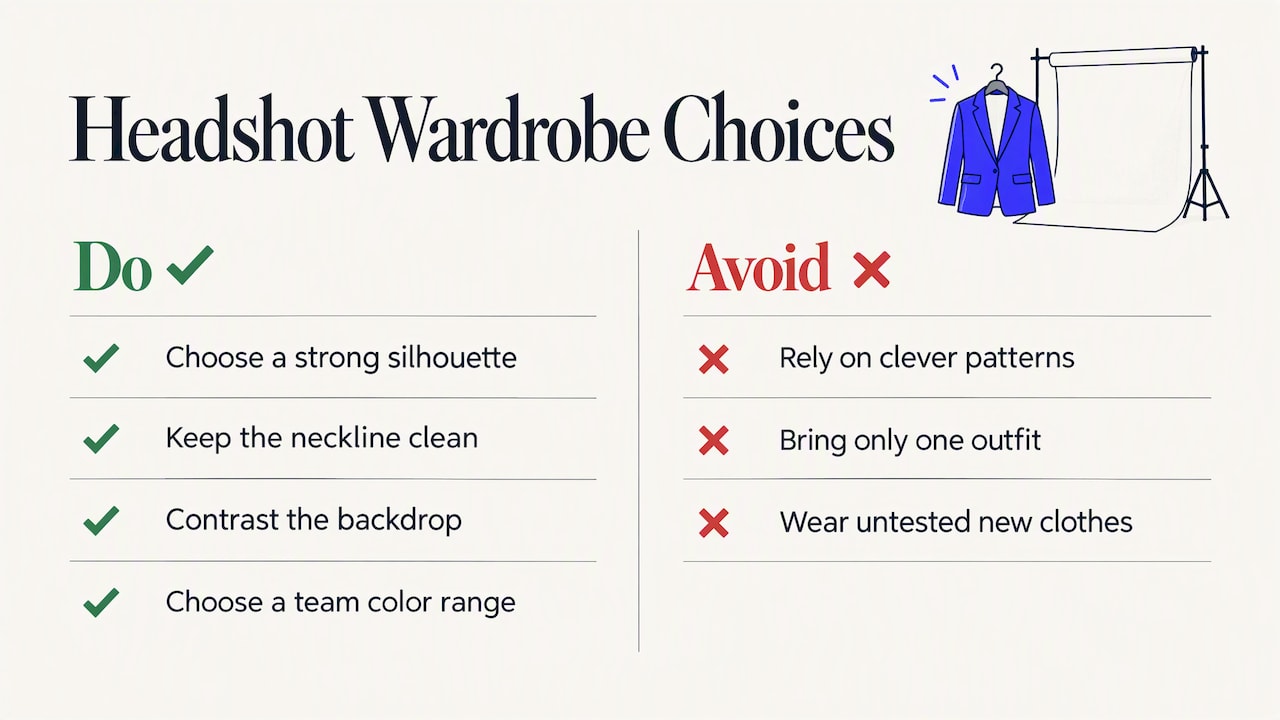
That last point shapes our advice. At small sizes, detail disappears and shape and color remain. A strong silhouette, a clean neckline and a color that contrasts with the backdrop will do more for you than a clever pattern. When we plan a team shoot, we ask clients to choose a color range rather than a single uniform, so each person looks like themselves while the page still feels cohesive.
We also encourage teams to treat headshots as part of their wider brand. The same people appear in videos, event coverage and speaker materials, so what they wear should line up with the visual identity of the company. Our work is built around business outcomes, and a headshot that makes a prospect trust you in five seconds is doing its job.
— Brandon V
How to run a team headshot day
If you are the person organizing headshots for a department or an entire company, a little structure prevents most problems.
- Send a one-page guide in advance. Include the recommended colors, what to avoid and the backdrop color. Mention that solids photograph best.
- Set a color palette, not a uniform. Two or three shades, such as navy, gray and one accent, keep the page consistent without making everyone identical.
- Ask people to bring a second option. A different top or an extra layer gives the photographer something to work with.
- Schedule short slots. Fifteen minutes feels rushed, but long gaps make people self-conscious. Tell your photographer your headcount and plan accordingly.
- Provide a steamer and a mirror. Last-minute adjustments make a visible difference.
- Plan for remote employees. If someone cannot attend, send them the same guidance so their photo does not look out of place beside the others.
For leaders who will also appear on video, our guides on preparing speakers for video interviews and filming executive interviews that build trust cover wardrobe, framing and delivery on camera, which overlap heavily with headshot advice.
A simple checklist for the night before
- Lay out two or three outfits, plus one extra layer.
- Steam or press every piece.
- Remove lint and check for stains in natural light.
- Choose simple jewelry and put aside everything else.
- Clean your glasses and decide whether to bring a backup pair.
- Get a normal night of sleep and drink water.
- Confirm the location, time and whether hair or makeup support is available.
If you wear a color you have never tested on camera, take a quick phone photo in natural light. It is not a professional test, but it will tell you whether the color brings out your face or drains it.
Professional headshots for your team or brand
If you need consistent, polished headshots for your leadership team, sales staff or conference speakers, we can plan the session around your brand, your backdrop and your schedule. See our corporate headshot photography services, or explore our wider corporate and marketing photography work. Tell us who needs to be photographed and where the images will appear, and we will recommend a wardrobe approach to match.
FAQ
What is the best color to wear for a headshot?
Navy is the most dependable choice, with charcoal gray as a close second. Deep jewel tones such as emerald, burgundy and teal also photograph well. Choose a color that makes your skin look healthy when you hold it near your face in daylight.
What should you avoid wearing for headshots?
Avoid fine stripes, tight checks, large logos, neon colors and very low or very tight necklines. Pure white and head-to-toe black can also cause problems depending on the backdrop. If you are unsure, test the outfit with a phone photo before shoot day.
Should I wear a suit for a professional headshot?
Only if it fits your industry and your audience. A tailored suit or blazer suits law, finance and executive roles, while an open-collar shirt or a blazer over a knit works well for many other fields. The rule of thumb is to dress one step above how you normally dress at work.
Should I wear my hair up or down?
Wear it the way you normally style it on a good day. If your hair is long, ask your photographer whether they prefer it forward over your shoulders or back, since this changes how the face is framed. Avoid trying a dramatically new style for the first time on shoot day.
Can I wear my glasses in a headshot?
Yes, but glare is the main risk. Tell your photographer in advance, especially if your lenses have an anti-reflective coating that tints in photos. They may adjust the lighting or angle, or suggest shooting some frames without lenses.
Sources
- Professional Dress and Attire, Auburn University Samuel Ginn College of Engineering
- 23 Professional Headshot Outfit Ideas, Lazy Girl Fits
- Career Portrait Lounge, Rutgers Career Exploration and Success
- Iris Photo Booth, Georgia Tech Career Center