



A B2B video strategy is a plan that ties every video your company makes to a business outcome, a specific buyer, and a stage of the buying process. It answers four questions before anyone picks up a camera: what result do you want, who must be convinced, which formats fit each stage, and how will you know it worked. This guide walks through each decision in order, so your marketing team can brief a production partner with confidence and measure what comes back.
TL;DR
- Pick one primary goal (awareness, leads, or sales) and choose metrics that match it before production starts.
- Build for a buying group, not one person: B2B video has to build trust and shared understanding across several stakeholders.
- Map formats to the funnel: short explainers for awareness, product videos and case studies for consideration, testimonials and onboarding for decision.
- Distribute where buyers already are, starting with your website and LinkedIn, and cut each shoot into several assets.
- Measure on four levels, from attention to business influence, and calculate ROI with a simple formula that counts every cost.
Table of Contents
- What a B2B video strategy actually is
- Step 1: Set one primary goal
- Step 2: Know the buying group
- Step 3: Match formats to the buyer journey
- Step 4: Plan the budget and production as a system
- Step 5: Choose your distribution channels
- Step 6: Measure what matters
- Our perspective
- Work with a team that starts with strategy
- A simple 90-day starting plan
- FAQ
- Sources
What a B2B video strategy actually is
B2B video marketing is how businesses create and share video to reach other businesses, educate them about solutions, and build professional relationships, according to HubSpot’s guide to B2B video strategy. The same guide points out that the approach is more targeted than consumer video, because it speaks to business decision-makers across longer sales cycles and often runs longer, roughly two to ten minutes.
That difference shapes everything. A consumer ad can win on emotion in a few seconds. A B2B video has to help a committee of people understand a complex offer, justify a spend, and feel safe choosing you. A strategy is what keeps your videos pointed at that job instead of becoming a pile of unrelated assets.
Why video earns a place in the plan
Video does three things well for business buyers:
- It makes complex solutions easier to grasp. WARC’s analysis of video in B2B says video reduces uncertainty and builds trust across the buying group.
- It creates shared understanding. The same analysis notes that video helps stakeholders evaluate options, align around a decision, and move forward with confidence.
- It scales personal touches. HubSpot notes that video enables scalable personalization for sales and support, including reusable, customizable demos.
Buyer behavior backs this up. MarketingProfs reports that 88% of surveyed B2B buyers watched videos to learn about products or services in the previous three months, and that about 93% say video matters in building trust in a brand.
Step 1: Set one primary goal
Most weak video programs share one trait: they try to do everything. A single video that aims to build awareness, capture leads, and close deals usually does none of them well.
DeepReel’s video content guide says video typically serves one of three purposes, building brand awareness, generating leads, or driving sales, and advises choosing one primary goal to start. Atlassian’s B2B video guidance makes a similar point: clarify your goals and metrics before production, whether that is lead generation, conversions, or brand awareness.
Make the goal specific. Goldcast recommends SMART objectives tied to revenue or funnel outcomes. Compare these two:
- Vague: “Raise awareness with a brand film.”
- Specific: “Use a two-minute brand film on our homepage and LinkedIn to lift demo requests from target accounts this quarter.”
The second version tells your production team the audience, the placement, the length, and the result you will judge them on.
Step 2: Know the buying group
B2B purchases rarely hinge on one person. A typical decision involves a champion who found you, a finance lead who worries about cost, a technical reviewer who worries about risk, and an executive who signs. Each asks different questions.
Goldcast suggests going deep on buyer personas, including the concerns and objections your sales team hears most. Atlassian likewise recommends using personas to shape messaging around pain points and product value.
A quick exercise that works well before any briefing:
- Ask sales for the five objections they hear most often.
- Note which role raises each one.
- Assign each objection to a video: a customer story that answers the finance question, a product walkthrough that answers the technical one.
- Write the single sentence each viewer should be able to repeat after watching.
This turns your video list into a response to real buying friction, which is far easier to defend internally than a list of formats you simply like.
Step 3: Match formats to the buyer journey
Once you know the goal and the audience, choose formats by stage. Goldcast maps them this way: short explainers and thought leadership for awareness, in-depth product videos, webinars and case studies for consideration, and customer testimonials and onboarding videos for decision. Demio suggests a similar sequence of short explainers, detailed product demos, and customer success stories.
| Stage | Buyer question | Video formats that fit | Typical goal metric |
|---|---|---|---|
| Awareness | Is this a problem worth solving, and who understands it? | Short explainer, thought leadership clip, founder or expert perspective, brand film | Views, watch time, share rate |
| Consideration | Does this solution fit our situation? | Product walkthrough, case study, webinar, event highlight | Form submissions, click-through rate, demo requests |
| Decision | Can we trust this team to deliver? | Customer testimonial, onboarding video, how-to | Conversions, revenue tied to viewers |
The metric column draws on DeepReel’s pairing of awareness with watch time and share rate, lead generation with form submissions and click-throughs, and sales with revenue attributed to video viewers.
Format is also a lever for efficiency. SmartBrief notes that a 60-second explainer, a customer story, and an industry expert viewpoint each change how the same information gets consumed, and that video can be repurposed into other assets when budgets are limited.
For a deeper catalog, see our breakdown of corporate video types and when to use each, or our look at 7 B2B video campaign examples that drive demand. SaaS teams may also want the best video styles for SaaS marketing.
Step 4: Plan the budget and production as a system
Treat video as a content engine rather than a one-off asset. Goldcast frames a scalable program as a system, with strategy first and each shoot feeding many outputs.
In practice, that means planning the edit before the shoot:
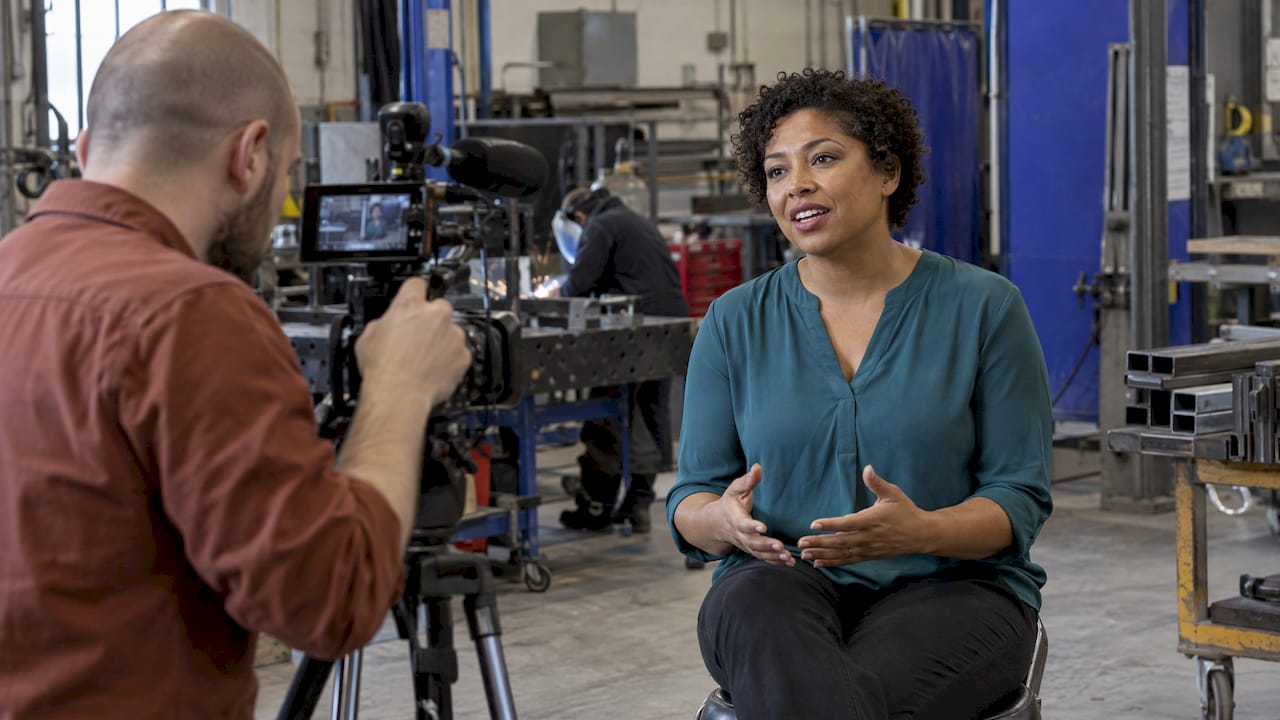
- Shoot once, cut many. One interview day with a customer can produce a three-minute case study, a 60-second LinkedIn cut, a quote clip for sales emails, and stills for a landing page.
- Capture event content with a purpose. Conferences and customer events generate testimonials, speaker clips and product moments that feed the consideration stage for months. If your calendar includes trade shows, plan the coverage with an event videography team that knows what the edit needs.
- Brief with brand guidelines. Share your guidelines, audience, goal, and placement up front so editing requirements are clear before footage exists.
- Budget for the whole life of the video. Production is only one cost. Distribution, internal time, and tools belong in the number too, a point that matters again when you calculate ROI.
We do not publish fixed prices because scope, crew size, locations and deliverables vary from project to project. The best way to get a realistic number is to bring your goal and deliverable list to a conversation.
Step 5: Choose your distribution channels
A strong video that nobody sees does no work. Distribution deserves its own plan, not an afterthought on release day.
Wistia’s 2026 State of Video findings, drawn from a survey of nearly 1,000 marketers and an analysis of more than 13 million videos, show that 83% of companies now share video on social media, with LinkedIn emerging as the top channel for B2B video. The same report found that website videos still bring the best return on investment, with homepage videos seeing a 24% play rate.
That suggests a sensible default pairing:
- Your website for the videos that convert: homepage brand films, product pages, case study pages.
- LinkedIn for reach among the right roles: thought leadership, short customer clips, event highlights.
- Email and sales outreach for personalized or reusable videos, such as a walkthrough sent to a prospect after a first call.
LinkedIn works best when people, not only the company page, share the content. A practical executive LinkedIn strategy can help leaders turn a customer story or event clip into a steady presence in their network.
For a fuller channel plan, read our corporate video distribution strategy guide.
Step 6: Measure what matters
Views alone rarely satisfy a CFO. Ampere recommends measuring B2B video at four levels:
- Attention: views, plays, and website play rate.
- Retention: average watch time, viewers still watching after 30 seconds, and drop-off points.
- Engagement quality: responses from target roles and accounts, such as comments, shares and replies.
- Business influence: sales sends, demo requests or trial starts from video pages, self-reported attribution, and video views by contacts on open opportunities when video data connects to your CRM.
Ampere also cautions against comparing platform-defined views as if they were the same unit across platforms. A view on one network is not a view on another, so judge each channel against its own baseline.
HubSpot adds that video analytics give visibility into buyer behavior that page views cannot match. When your sales team can see that the finance contact on an open deal watched the case study twice, that is a signal worth acting on.
If you also run outbound or paid programs alongside video, it helps to understand paid lead generation models and costs so you can compare what video-assisted pipeline costs against other channels.
Calculating video ROI
Green Frog Labs gives this formula: Video ROI = (Revenue Attributable to Video minus Total Video Cost) divided by Total Video Cost, times 100. Total cost includes production, distribution, internal time, and tool costs. Attributable revenue includes direct conversions, influenced pipeline, and indirect lift measured through controlled experiments.
A worked example with made-up round numbers: if a program’s total cost is $50,000 and the revenue you can attribute to it is $200,000, the ROI is ($200,000 minus $50,000) divided by $50,000, times 100, which is 300%. The point is the method: count every cost, and agree with sales in advance on what counts as attributable revenue.
For tactics that lift the return on what you already make, see how to improve video marketing ROI with better strategy.
Our perspective
Most B2B teams come to us with a format in mind: a brand film, a testimonial, an event recap. We start one step earlier. What business outcome is this video supposed to move, and who has to be convinced for that to happen?
That question is the center of how we work. Our process is built around return on investment, so creative decisions are filtered through business outcomes: leads, pipeline and growth. A beautiful video that never reaches the right buyer is a missed opportunity, and a plain one that answers the right objection at the right moment can carry a deal.
We also believe in planning the whole content engine up front. A single shoot day can supply a hero film, short social cuts, testimonial clips and photography when the edit is mapped before we arrive. With a network of professionals across the nation, we can staff specialized crews in major cities, so a national campaign or multi-city event series keeps one consistent look and standard.
Our advice: choose one goal, brief us on your buyers, and let the strategy decide the formats.
Brandon V
Work with a team that starts with strategy
V2 Visuals produces corporate, marketing, and brand storytelling videos, event videography, photography, motion graphics, and ad creative for businesses and marketing teams across the United States. We begin with your goals and audience, then build the shoot and edit around the outcome you want.

If you are planning a B2B video program, explore our corporate and marketing video production services or contact us through our site to talk through your goal, audience and deliverables.
A simple 90-day starting plan
If you are starting from zero, resist the urge to launch ten videos. A focused first quarter is easier to measure and easier to learn from.
- Weeks 1 to 2: Define one primary goal and collect objections from sales. Confirm which roles in the buying group you most need to reach.
- Weeks 3 to 4: Pick two formats that match your goal, for example a brand or product film for your website plus a customer story. Write the brief, including placement, length and call to action.
- Weeks 5 to 8: Produce and edit, planning short cuts for LinkedIn and a sales-ready version from the same footage.
- Weeks 9 to 12: Publish, track attention, retention, engagement quality and business influence, and review with sales which videos came up in real conversations.
At the end, you will know which format earned attention, where viewers dropped off, and which video your sales team actually uses. That evidence tells you where to invest next, and it gives you the numbers for your ROI calculation.
FAQ
What is the difference between B2B and B2C video strategy?
B2B video targets business decision-makers across longer sales cycles and often runs longer, around two to ten minutes, while B2C leans on short, emotion-driven clips meant to prompt a quick purchase. B2B also has to satisfy several stakeholders at once. That is why education, trust and clarity usually matter more than speed.
How long should a B2B marketing video be?
It depends on the stage. Awareness videos tend to work as short explainers or clips, while consideration content such as product videos, webinars and case studies can run longer. HubSpot cites roughly two to ten minutes as common for B2B overall. Plan a short cut and a long cut of each key story.
Where should we publish B2B videos?
Start with your website and LinkedIn. Wistia’s 2026 findings show LinkedIn as the top channel for B2B video and website videos delivering the best return on investment. Then reuse the same footage in email and sales outreach.
How do we prove a B2B video is working?
Track four levels: attention, retention, engagement quality and business influence. Then apply the ROI formula, counting production, distribution, internal time and tool costs against revenue attributable to video. Agree with sales beforehand on how attribution will be handled.
Sources
- Building a B2B Video Marketing Strategy With Impact, HubSpot
- Why Video for Modern B2B Marketing Success, MarketingProfs
- Unlocking the Value of Video in B2B, WARC
- How to Build a Video Content Strategy from Scratch, DeepReel
- How to Build a B2B Video Marketing Strategy, Atlassian
- B2B Video Production Guide, Goldcast
- B2B Video Marketing: The Complete Guide for Marketers, Demio
- Why video deserves a place in your B2B marketing mix, SmartBrief
- Key Takeaways From Wistia’s 2026 State of Video, Wistia
- B2B video marketing strategy: what to make and how, Ampere
- Video Marketing ROI: How to Measure and Prove Value, Green Frog Labs
- Executive LinkedIn Strategy: A Practical B2B Playbook
- Paid Lead Generation for B2B: Models, Costs and How to Choose
Pingback: Sales Enablement Video: Types, Examples and How to Build Them
Pingback: What Makes a Cinematic Commercial Actually Work? - V2 Visuals - Photo & Video Production