


A brand identity in the United States can cost anywhere from a couple of thousand dollars to well into six figures. One 2026 industry roundup reports that branding agency projects run from $2,500 to over $500,000, depending on scope, strategy depth and agency expertise. The number you land on depends less on the logo and more on how much research, system design and rollout sits behind it. This guide shows where the money goes, what each budget level should include, and how to compare quotes without getting burned.
TL;DR
- Branding agency projects commonly run from $2,500 to $500,000+, so the useful question is what scope a quote covers, not what the average is.
- Among agencies in one 2026 data set, 42% set a minimum project budget of $25,000 or more.
- Research depth, stakeholders, naming, revision rounds and rollout work move the price most.
- Budget beyond the package: trademark filing, font licenses, photography and the time to roll the brand out.
- Ask for written scope, file ownership and a guidelines document before you sign anything.
Table of Contents
- What you are actually buying
- Brand identity cost by provider type
- What drives the price up or down
- What to budget at each level
- The costs outside the package
- Perspective: why we price the outcome, not the logo
- How to compare quotes
- Match the budget to your stage
- Working with V2 Visuals
- FAQ
- Sources
What you are actually buying
People use “logo,” “brand identity,” “branding” and “corporate identity” almost interchangeably, and quotes vary because the deliverables do. A logo is one asset. A brand identity is the system around it: how the company looks, sounds and behaves across every place customers meet it.
A traditional agency engagement typically covers positioning and identity guidance, visual design, naming, style guides, templates and copywriting support. In practice, a complete identity usually breaks down like this:
- Strategy and positioning: who the brand is for, what it promises, how it differs from competitors.
- Logo suite: primary mark, secondary versions, icon, and one-color and reversed variations.
- Color palette and typography: defined with exact values for screen and print, plus a type hierarchy.
- Brand guidelines: the document that tells designers, vendors and employees how to use everything.
- Collateral: business cards, letterhead, presentation templates, email signature.
- Digital assets: social media templates, profile images, web styling.
If you only need the first item on the second line, read our breakdown of what businesses really pay for logo design. If you need the whole list, keep reading.
Brand identity cost by provider type
The same project is priced very differently depending on who does it. Four routes cover most of the market.
| Route | Typical fit | What you get | Main risk |
|---|---|---|---|
| Template or marketplace logo | Side projects, very early tests | A finished mark or kit, little customization | No strategy, hard to protect or extend |
| Independent designer | Startups, small local businesses | Custom logo and core identity, focused scope | One person’s capacity and range |
| Boutique studio | Growing companies, regional brands | Strategy plus identity system and guidelines | Less breadth for large rollouts |
| Full-service agency | Multi-market or multi-stakeholder rebrands | Research, naming, identity, rollout support | Highest cost, longer timelines |
On the agency end, hourly rates give a rough floor. Clutch’s 2026 guide reports that the average hourly rate for a US branding agency is $100 to $149. It also notes branding packages that start at around $1,000 per month and can reach about $15,000 per month, with full corporate branding projects costing significantly more than a simple logo.
Those retainer and hourly figures describe how agencies bill, not what your project will cost. Pricing structures in this industry include per-unit fees, hourly or day rates, fixed project fees, monthly retainers and occasionally value-based pricing. For a defined identity project, a fixed project fee tied to a written scope is usually the easiest to budget and compare.
Why agency prices run high
Research from The 30 Top suggests that branding projects are led by senior strategists and designers from start to finish, with very little cheap junior production work. That keeps blended rates high. The same source notes that agencies price the value of a small number of strategic decisions rather than raw hours, because brand assets get used for years across every channel.
What drives the price up or down
When two quotes for “a brand identity” differ by a factor of five, the gap is almost always one of these factors. The 30 Top lists the main ones: depth of research, number of stakeholders, naming and legal clearance, number of markets or languages, revision rounds, and overall breadth of deliverables and rollout.
Research and strategy
A designer who starts drawing on day one costs less than a team that interviews customers, audits competitors and writes a positioning statement first. The first approach is fine when you already know who you serve and how you differ. The second protects you when you do not, and when the brand must hold up across sales decks, trade shows and video.
Stakeholders and revision rounds
Every additional decision-maker adds feedback cycles. A founder-led company with one approver moves fast. A corporate team with legal, marketing and leadership reviewing each round needs more meetings, more revisions and more project management. Ask how many rounds are included and what an extra one costs.
Naming and clearance
Naming is a separate discipline. If you need a new company or product name, expect it to be scoped and priced on its own, especially when legal clearance is involved.
Markets, languages and rollout
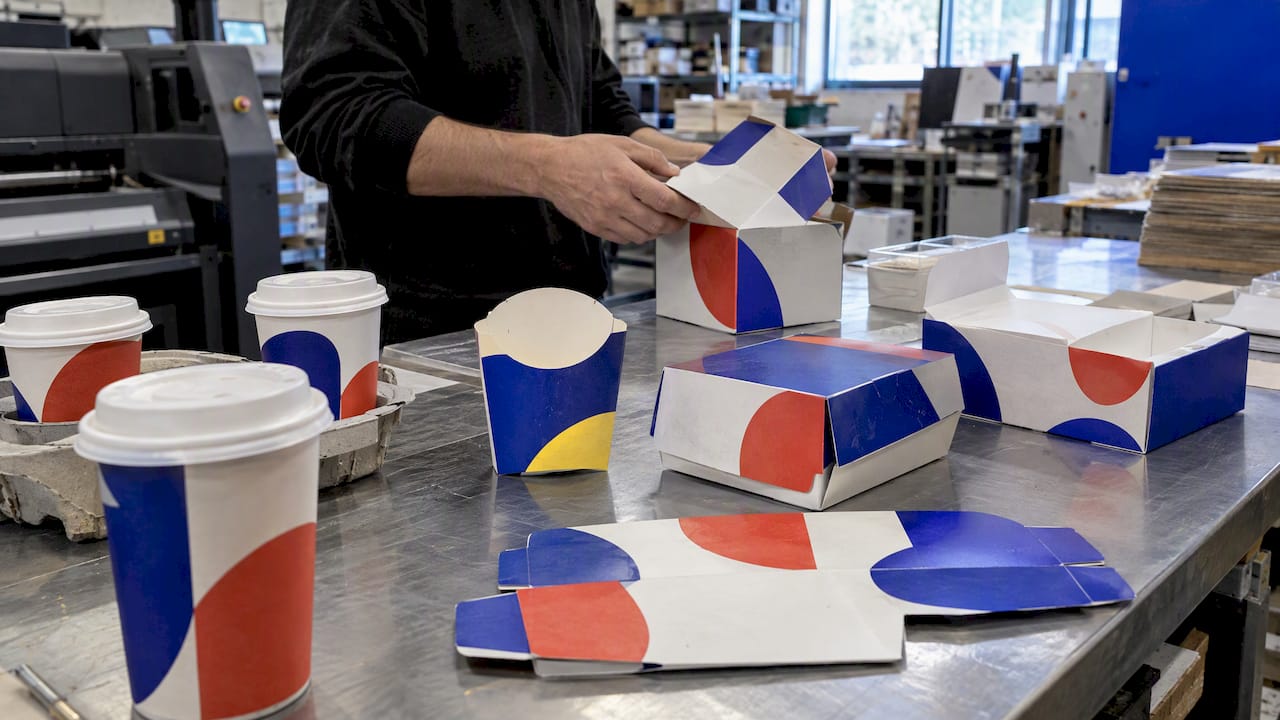
A brand that has to work in several markets, languages or physical locations needs more adaptation and more documentation. Rollout, meaning applying the identity to your website, signage, packaging and print, is often the largest hidden line in a budget. For a restaurant group, for example, the identity has to carry onto custom food packaging such as cups, boxes and sleeves, and each of those formats needs its own artwork checks.
What to budget at each level
Instead of quoting single numbers that vary by vendor, think in terms of what each budget should buy.
Entry level (a logo and a basic kit). You should receive a logo in the formats you need, a color palette and font recommendations. Expect little or no research and a short guidelines page at most. This suits businesses testing an idea.
Core identity (the typical small-business project). You should receive a logo suite, palette, typography, a brand guidelines document, and a handful of collateral and social templates. A short discovery phase should come first. This is the right level for most companies with a proven offer and a growth plan.
Strategic identity (research-led). You should receive everything above, plus customer or stakeholder research, positioning, messaging and a fuller guidelines manual covering photography direction, iconography and usage rules. This suits companies entering new markets or competing against established brands.
Full rebrand (enterprise or multi-market). Add naming, legal clearance, internal launch materials, rollout planning and often a website rebuild. These projects sit at the top of the market range and take months, not weeks.
A thorough guidelines document is the clearest sign you are buying a system rather than a drawing. A good style guide covers positioning, logo usage, typography rules, color values in RGB, CMYK and hex, photography direction, graphic elements and iconography. Ask to see a sample page before you commit.
The costs outside the package
The quote is rarely the total. Plan for these separately:
- Trademark protection. Filing with the US Patent and Trademark Office is charged per class of goods or services, and many owners add an attorney’s review. Check current fees on the USPTO’s official fee schedule before budgeting.
- Font licenses. Commercial typefaces are licensed, often by use case (web, app, print). Ask whether licenses are included or passed through.
- Photography and illustration. A new identity looks thin on stock images. Custom brand photography and video give it life, and they are priced as their own production.
- Additional revisions. Anything beyond the contracted rounds is billed.
- Rollout time. Your team’s hours matter too, because updating a website, signage, packaging, email systems and printed materials takes real work.
Perspective: why we price the outcome, not the logo
We produce video and photography for businesses, and we see the same pattern on nearly every project: the identity is only as useful as what it becomes in the real world. A beautiful logo sitting in a PDF does not generate a lead. A system that a videographer, a web developer and a sales team can all pick up and apply consistently does.
That is why we look at brand identity through return on investment. Before asking what it costs, we ask what the brand has to do: win a pitch, make an event feel premium, give a recruitment video a recognizable look, make an ad campaign instantly attributable. The scope follows from those answers. A company that mostly sells through trade shows needs different assets than one that sells through paid social.
Our advice to buyers is simple. Pay for strategy where you are unsure of your positioning, and pay for craft where you already know it. Insist on guidelines clear enough that someone who has never met the designer could use them. And plan the visual content, whether photography, corporate video or animation, at the same time as the identity, so the brand and the footage are built to match rather than retrofitted.
— Brandon V
How to compare quotes
Two proposals can look identical on the surface and differ in what matters. Work through this list for each one.
- Scope in writing. Which deliverables, in which file formats, and what is explicitly excluded?
- Process. Is there a discovery phase? Who attends, and what does it produce?
- Revisions. How many rounds per stage, and what does an extra round cost?
- Ownership. Do you receive full rights and the source files on final payment? Get this in the contract, not in an email.
- Guidelines. Is a guidelines document included, and how detailed is it?
- Who does the work. Will the senior person you meet also do the design?
- Timeline. Weeks for an entry-level project, months for a strategic one. Beware of both extremes.
- Rollout. Does the price include applying the identity to your key touchpoints, or only delivering the files?
A word on ownership, since it comes up often: do not assume you own a logo just because you paid for it. The contract decides. Look for language that assigns the rights to you on full payment and promises source files with final delivery.
And be careful with the lowest bid. Cheap packages usually leave out the parts that make a brand usable: strategy, guidelines, variations and revisions. You then pay to fix those gaps later, often to a second provider.
Match the budget to your stage
Use your business stage to narrow the field.
- Pre-launch or validating an idea: keep it simple. A clean logo and basic kit are enough until revenue proves the concept.
- Early revenue, preparing to scale: invest in a core identity with guidelines, so every new hire, vendor and freelancer produces consistent work.
- Established company with a dated look: a research-led refresh usually beats a clean-sheet rebrand, and it keeps the equity you have built.
- Entering new markets or merging: budget for strategy, naming and a structured rollout from the start.
Once the identity exists, the next spend is usually content that brings it to life. Corporate video formats such as brand films, explainers and testimonials are where the palette, typography and tone get tested in public. Planning them alongside the identity avoids duplicate work.
Working with V2 Visuals
We help brands, marketing teams and event organizers turn a brand into content that performs, with video production, photography, motion graphics, branding and visual identity work, brand guidelines, ad creative, and website and app development. Our projects are scoped to your goals and audience, and we can draw on a network of professional crews across the country.
If you are weighing a new identity and want to see how it will translate to film and photography, start with our video production services or talk to us about the wider creative and branding work we do.
Tell us what the brand needs to achieve and we will recommend the right scope. Project pricing is quoted per engagement, so contact V2 Visuals for a tailored estimate.
FAQ
How much should a small business spend on brand identity?
That depends on stage and scope, not on a fixed figure. Published ranges are wide, from a few thousand dollars on the low end of agency work to far more for strategic projects. Decide first which deliverables you need (logo, guidelines, collateral, rollout), then request fixed-scope quotes for exactly that list.
What is the difference between brand identity and a branding package?
Brand identity is the set of visual and verbal assets that represent your company. A branding package is how a provider bundles and sells those assets, so contents differ by vendor. Compare packages by their deliverable lists and guidelines rather than their names.
Do I own the logo if I pay someone to design it?
Not automatically. Ownership is set by your contract. Ask for a written assignment of rights on final payment and delivery of the editable source files, and confirm that any licensed fonts or stock elements are covered.
Is a corporate identity more expensive than a brand identity?
Usually, because corporate projects involve more stakeholders, more markets and a larger rollout. Clutch notes that full corporate branding projects cost significantly more than a simple logo design. The deliverables are similar, but coordination and application across the organization add cost.
Why do brand identity quotes vary so much?
Because scope varies. Research depth, the number of approvers, naming, revision rounds and rollout requirements all change the work involved. The lowest and highest quotes are often not describing the same project.
Sources
- Clutch: Branding Pricing Guide
- The 30 Top: How Much Does Branding Cost in 2026?
- Dribbble: Understanding Branding Agency Costs
- Superside: Branding Package Guide