



Video usage rights are the license that spells out where your company can run a video, for how long, in what edits and alongside whom. Paying for a video gets you a file. The contract gets you the permission to use it. The safest way to protect your investment is to settle usage terms during scoping, before the shoot, with a production partner that plans video around business outcomes rather than around a single deliverable. At V2 Visuals, that is how we approach corporate video, event coverage and photography.
This guide is for marketing teams, event organizers and corporate buyers who commission or license video. It explains who owns what, which terms to pin down, how licensing fees are shaped and where companies get caught.
TL;DR
- Under U.S. copyright law the creator owns a work when it is created. Paying for a video does not transfer ownership unless the contract says so or the work qualifies as made for hire.
- Every usage license reduces to scope (media and placement), territory, duration, exclusivity and editing rights. Each one you push outward usually raises the fee.
- Paid placement, such as ads on social, connected TV or broadcast, is the line where usage terms matter most.
- Music, people and locations in a video carry their own permissions. A finished video can be licensed correctly and still be unusable because of a song.
- Decide how you will use the video over the next two to three years before you sign, not after the first campaign runs.
Table of Contents
- Ownership and usage are two different things
- The five terms every usage license should state
- What affects video licensing fees
- Music, people and places inside the video
- When you can use a video without a license
- What is at stake if you use video without permission
- A practical checklist before you commission or license
- Where V2 Visuals fits
- Perspective
- FAQ
- Sources
Ownership and usage are two different things
Copyright belongs to the creator at the moment a work is fixed, whether that is a film, a clip or a photo. As the Creators Guild of America explains, payment alone does not move that ownership. A creator who assumes the fee “sold the video” can give away rights that were never priced in, and a buyer who makes the same assumption may find out later that the rights were never theirs.
There are two ways a company ends up owning the finished work:
- A written assignment. The contract states that copyright transfers to your company.
- Work made for hire. The U.S. Copyright Office explains that a commissioned work can be a work made for hire only when it fits certain categories and the parties sign a written agreement. If the work is made for hire, the hiring party is treated as the author and owner.
Everything else is a license. A license is permission to use the work in defined ways. Most business buyers do not need to own every frame. They need a license broad enough to cover what they plan to do, written clearly enough that nobody argues about it in two years.
Final cut, raw footage and project files
One distinction catches marketing teams off guard: the finished video and the material behind it are different assets. The deliverable is the approved edit. Raw footage, unused takes, project files and graphics sources are separate, and a contract can treat them separately. If you expect to cut a new version next year, to pull clips for social or to hand the project to another editor, say so in the scope. Ask in writing what happens to the source material, whether you will receive it and in what format. It is far easier to include this at the start than to negotiate it after the final delivery.
The five terms every usage license should state
Licensing guidance from legal and creative professionals converges on the same checklist. A content licensing checklist from Kohler Law Group lists the specific copyright rights granted (reproduction, distribution, display, performance, adaptation), the media, territory, duration, exclusivity and editing rights, plus credit, releases, fees and termination. For a marketing buyer, that boils down to five questions.
1. Media and placement
Where will the video run? Organic social, your website, email, a trade show screen, paid social, connected TV, broadcast, cinema, out-of-home displays and internal training are all different uses. If the contract lists website and organic social, running the same video as a paid ad is outside the license. Anything not explicitly licensed is not licensed.
Paid placement is usually where pricing steps up. An organic post reaches people who already follow you. A paid campaign buys reach to audiences who have never heard of you, and rights holders price that extra exposure accordingly. If you might put media spend behind a video, get that written in at the start. We cover how paid video performs in our guides to paid social ads and LinkedIn video ads.
2. Territory
Will the video run only in the United States, in specific regions or worldwide? Online does not automatically mean worldwide in a contract. If you are a U.S. company with a global website, ask whether the license covers visitors outside the country. If you only advertise domestically, a narrower territory may lower the fee, but only if you are certain you will not expand.
3. Duration
Duration runs from a short campaign window, such as three months, to perpetuity. Clarify the start date, how long the term lasts and what happens at the end: renewal, takedown or a fee for continued use. A perpetual license for the final approved deliverable is common on corporate work, but it should still name the channels it covers.
4. Exclusivity
Exclusivity answers whether the creator or licensor can offer the same material to others. It can be limited by category (no competing software brands), by time (six months) or by media. Exclusivity has a price, because it removes the creator’s ability to earn from the work elsewhere. Do not pay for exclusivity you do not need, and do not assume you have it if the contract is silent.
5. Editing and derivative rights
Can you cut a 15-second version from a two-minute film? Add captions, crop to vertical, swap the call to action, translate the voiceover? Adapting a work is one of the exclusive rights a copyright owner holds, so it has to be granted. For modern campaigns, cutdowns and format changes are routine, so confirm them. Our guide on how to repurpose event footage shows how much value sits in re-edits, and why those rights are worth securing early.
What affects video licensing fees
Video licensing fees are not one standard rate. They move with the same variables as the terms above: how many media, how large a territory, how long and how exclusive. Add the production value of the footage, the people and property it shows and any music rights, and you see why two quotes for “a video license” can differ widely.
Some published numbers show the structure. A stock and content licensing page from FlickDirect lists starting rates of $100 per original image for perpetual non-exclusive editorial website use, $300 per image for 12-month commercial advertising or print use and $500 for an original video clip of up to 30 seconds per project, and says rates vary by territory, duration, exclusivity, platform and scope. Those are starting points from one source in 2026, not benchmarks for a commissioned brand film. They do show the pattern: commercial and advertising uses cost more than editorial ones, and shorter terms cost less than perpetual ones.
The most common payment structures are:
- Flat-fee buyout. One payment covers the agreed use. This is typical for corporate videos.
- Royalties. The licensor earns a share of revenue or a fee at view milestones, more common for entertainment or distribution deals.
- Advances against royalties. An upfront payment credited against future royalties.
When a license involves ongoing fees, the contract should define the revenue base, payment timing and audit rights, as the Kohler checklist points out. For a straightforward commissioned corporate film, a flat fee with clear terms is usually the simplest structure to plan around.
When you commission video from a production company, usage terms are frequently built into the project price rather than itemized. That is the cleanest route: one scope, one fee, and a clear description of where the video can run. For a sense of what drives the project price itself, see our breakdown of video production costs for businesses.
A worked example
Say your company commissions a three-minute brand film for your website and a conference booth, then decides in month four to run 15-second cutdowns as paid social ads across the country.
- Original scope: website and event screens, U.S., perpetual, non-exclusive, no edits mentioned.
- New plan: paid social, cutdowns, captions, a 12-month campaign.
Three things are now outside the original grant: the paid media, the cutdowns and possibly the captioned edits. You would need to go back and amend the license, usually at an added cost, and possibly on a deadline you did not plan for. Had the original scope listed “owned and paid digital media, edits and cutdowns, U.S.,” the same video would have been usable from day one. Writing the likely uses into the first agreement is almost always cheaper than amending later.
Music, people and places inside the video
A video can be well licensed and still be unusable for your plan, because it contains other people’s rights.
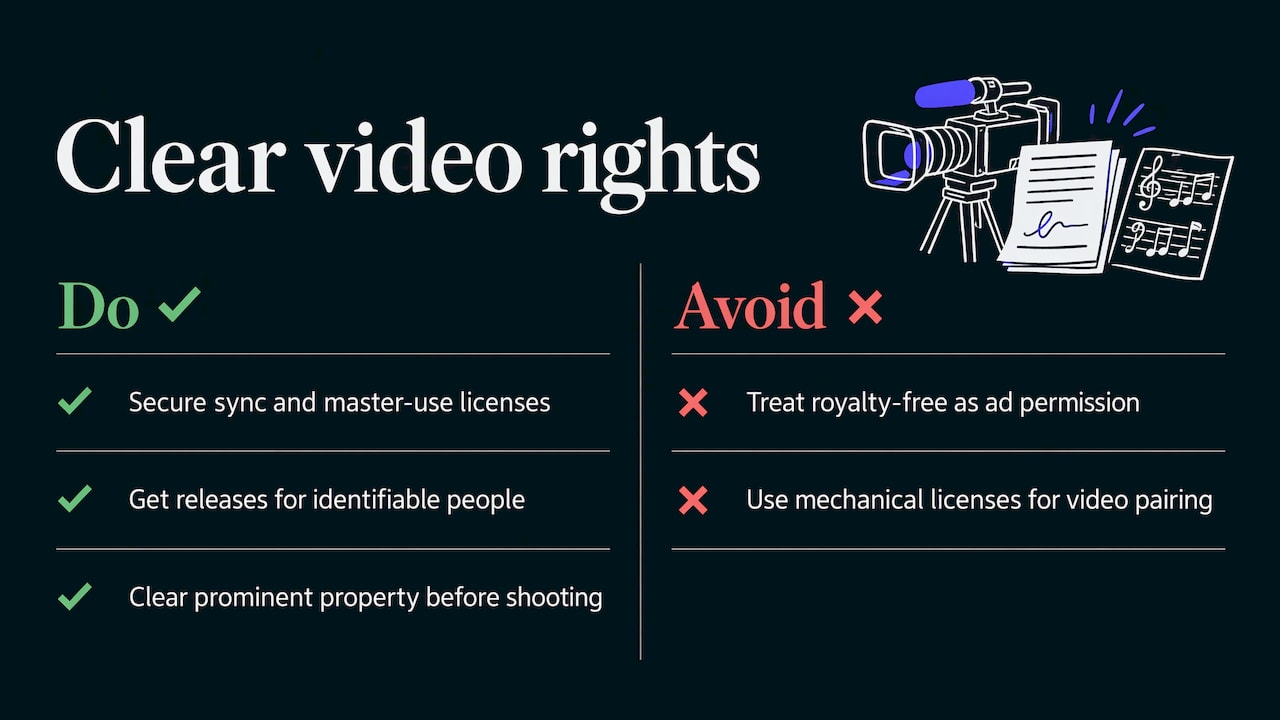
Music. Putting someone else’s music under visuals requires a synchronization license for the composition, and using a specific recording requires a separate master use license. In the U.S., sync fees are negotiated rather than set by statute, and a mechanical license (the kind used for audio reproduction) does not cover pairing music with video, according to a 2026 music licensing guide. “Royalty-free” describes how you pay, not what you are allowed to do, and it does not automatically extend to paid advertising or broadcast. If your video runs at a live event with a performer or band, the same questions apply, as this overview of music copyright for events shows.
People. When a video or photo shows identifiable people and will be used commercially, you generally need signed releases. A good release covers the content, permitted uses (paid ads, organic social, website, email, print, internal), territory, duration, editing rights and, for minors, a parent or guardian’s consent. At corporate events, attendee notices and speaker releases are the practical way to cover this. Our overview of what to expect from a corporate event video package explains how event coverage is typically scoped.
Locations and branded items. Private property, logos and artwork that appear prominently may need permission, so clear them before the shoot rather than during the edit.
When you can use a video without a license
Some use needs no permission, though fewer cases than most teams assume.
- Public domain. The University of Michigan Library’s copyright guide notes that works not subject to copyright, or whose copyright has ended, can be used without permission. In the U.S., that includes works published before March 1, 1989 without the required formalities, works whose term has expired and works dedicated to the public.
- Public licenses. Material released under a Creative Commons license can be used without asking again, but only on its terms. Attribution requirements or bans on commercial use still apply, which matters if the video promotes your business.
- Fair use. The U.S. Copyright Office states that fair use can allow limited use for purposes such as commentary, criticism and news reporting, and that no fixed number of seconds or percentage guarantees protection. Whether a use qualifies depends on all the circumstances. A promotional video for your company is a commercial use, so it is not a safe place to rely on fair use. For ads and marketing, get a license.
What is at stake if you use video without permission
The cost of getting this wrong is not just an awkward email. Under federal law, a copyright owner who proves infringement can recover actual damages and profits or elect statutory damages. Section 504 of the Copyright Act sets statutory damages per work, with higher amounts available for willful infringement. Statutory damages and attorney’s fees generally depend on the work having been registered before the infringement or within three months of first publication. Platforms can also remove ads and flag accounts that use unlicensed material, which interrupts a campaign at the worst moment.
An indemnification clause in your contract decides who pays for legal defense and settlements if a third party claims the video infringes. Read it, and ask your counsel about it for any high-value or broadcast project. For specific legal questions about a contract or a claim, an attorney who handles intellectual property is the right person to consult.
A practical checklist before you commission or license
- List every intended use. Website, social (organic and paid), email, sales decks, event screens, recruitment pages, broadcast, trade shows.
- Set the territory and the time horizon. Think two to three years ahead, not just the launch.
- Decide on exclusivity. Is it needed, for which category and how long?
- Ask for edit rights. Cutdowns, vertical crops, captions, translations and updates.
- Clarify the source material. Raw footage, project files and graphics: delivered or retained?
- Confirm clearances. Music licenses, talent and attendee releases, location permission.
- Get it in one document. Scope, fee, usage terms, approvals and what happens at the end of the term.
If you are weighing in-house shooters, freelancers or a full-service team, usage terms are one of the differences worth comparing. Our guide to agency versus freelance videographer walks through the others.
Where V2 Visuals fits
Usage rights are easier to get right when the person scoping your video asks what the video is supposed to do for the business. V2 Visuals produces corporate and marketing video, branding and storytelling films, event videography and photography, and ad creative and social content for brands, corporate teams and event organizers. We work with a nationwide network of professionals and filter creative work through business outcomes, so the conversation about where a video will run, and for how long, belongs at the start of every project.
If you are planning a brand film, an event shoot or a campaign with paid distribution, start with our video production services and tell us how you expect to use the footage.

For event teams, our event videography and corporate photography services cover live coverage, headshots and brand imagery, with the same scoping conversation about use.
Perspective
Most usage disputes we hear about are not about bad faith. They happen because a video was bought for one purpose and then asked to do three more. A conference recap becomes a paid LinkedIn campaign. A brand film becomes a recruiting asset. Each of those uses is a good idea, and each should be written into the scope before the first day of production.
Our view is that a video should be planned around the return it is meant to produce. That means mapping the channels, the audiences and the likely re-edits first, and letting the usage terms follow from that plan. When the plan is clear, the license is simple, and the footage keeps working long after the launch.
For event organizers, that planning matters even more. One shoot can feed highlights, speaker clips, sponsor deliverables and next year’s sales material. Deciding up front which of those you will need turns one day of coverage into months of content.
Brandon V
FAQ
Does paying for a video mean my company owns it?
Not automatically. Under U.S. copyright law the creator owns the work unless the contract assigns it to you or it qualifies as a work made for hire under a signed written agreement. In most commercial projects, a company receives a license to use the final deliverables for defined purposes. Check the contract to see which applies.
Can I use a commissioned video in paid ads?
Only if the license covers paid media. Organic social and website use are often listed separately from paid placement on social, connected TV or broadcast. If you may promote the video with ad spend, name paid use and the platforms in the scope from the start.
How are video licensing fees set?
They depend on the media, territory, duration and exclusivity you need, plus the footage and any third-party rights such as music. Commercial and paid uses cost more than editorial or organic ones, and perpetual or exclusive terms cost more than short, non-exclusive ones. For commissioned corporate work, usage is often included in the project fee.
Can I use a few seconds of a copyrighted song or clip in my marketing video?
There is no safe number of seconds. The Copyright Office says no rule allows a specific length, and fair use depends on the circumstances. Promotional use is commercial, so obtain a license for the music or footage before you publish.
Sources
- Licensing and Usage Rights, Creators Guild of America
- Circular 30: Works Made for Hire, U.S. Copyright Office
- Content Licensing Agreement Checklist, Kohler Law Group
- FlickDirect Licensing
- Music Sync Licensing 2026: Rights and Royalties, GTC
- Using Video Without Permission, University of Michigan Library
- Fair Use FAQ, U.S. Copyright Office
- 17 U.S. Code § 504, Cornell Legal Information Institute
- Wedding Music Copyright: What Couples Need to Know