



A brand refresh updates how your company looks and sounds while keeping what it stands for. A rebrand changes what it stands for, and often its name too. If your positioning, audience and name still work but your visuals, video and photography have aged, you need a refresh. If your business has structurally changed, you need a rebrand. Either way, the decision is only as good as the assets that carry it into the market: the film, the photography, the website and the brand guidelines your team uses every day.
This guide gives marketing teams, event organizers and business owners a practical way to make that call, a checklist to run it, and a way to prove it paid off.
TL;DR
- A refresh keeps your core identity and strategy and modernizes the expression. A rebrand redefines positioning, messaging and sometimes the name.
- Choose a rebrand after structural change: a merger, a new market, a name that limits growth or a reputation problem. Choose a refresh when the strategy holds but the look and content feel dated or inconsistent.
- Cost scales with scope, and the design fee is only part of it. Rollout across your website, video, collateral and events is where budgets grow.
- Set baselines before launch, then track leads, branded search and sales results, not just whether the launch went smoothly.
- Fresh video and photography are what make a new or updated brand visible to buyers.
Table of Contents
- What each approach actually changes
- When a brand refresh is the right call
- When a full rebrand is warranted
- A five-question test you can run this week
- What refreshes and rebrands look like in practice
- What each path costs
- A checklist for a refresh or rebrand
- How to tell whether it worked
- Common mistakes to avoid
- Put your refreshed brand on screen
- FAQ
- Sources
What each approach actually changes
The two terms get used loosely, so start with a precise split.
A brand refresh is an update to one or more elements of your brand identity that produces a new version of the same brand, not a new brand. You keep the loyalty you have built and the touchpoints customers already recognize. Typical changes are the logo, typography, color palette, tagline and writing style.
A rebrand is a complete overhaul. HubSpot describes it as changing brand positioning, values, guidelines and the mission and vision statements, and says it is usually enacted when the current strategy is failing. Shopify adds the other common triggers: new ownership, a merger or entry into a new market.
A useful shorthand comes from a brand strategist quoted by eMarketer: one is cosmetic, and the other is a fundamental rethinking of what the brand is, who its audience is and what it is trying to achieve.
| Brand refresh | Rebrand | |
|---|---|---|
| Core strategy and positioning | Stays | Redefined |
| Name | Stays | May change |
| Visual identity | Updated | Rebuilt |
| Messaging | Sharpened | Rewritten around a new position |
| Audience impact | Familiar, “same brand, better” | Audience must relearn who you are |
| Rollout | Focused on the touchpoints that look dated | Every touchpoint, internal and external |
| Risk | Low, if core equity is protected | Higher, because recognition is reset |
When a brand refresh is the right call
Most business problems that feel like a branding crisis are really expression problems. Your offer is sound and your customers know you, but your presentation has fallen behind. A refresh fits when:
- Your positioning still describes what you do and who you serve.
- Your visuals look dated next to competitors that have modernized.
- Your materials are inconsistent: the website, the sales deck, the event booth and social profiles each look like a different company.
- Your video and photography no longer reflect the quality of your product or service.
- You want to signal momentum without throwing away recognition.
That last point matters more than it sounds. Recognition is an asset you have already paid for. The Hershey Company’s newsroom account of its award-winning refresh is a good model: it updated voice, visuals, colors and brand silhouettes while keeping the corporate logo with its Kiss silhouette unchanged, and the work took about a year. Big brands treat the thing people already recognize as the anchor and modernize around it.
A refresh is also where you can move fastest. Because the strategy is settled, the work concentrates on a defined list of assets: the visual system, the tone of copy and the content that shows the brand in action.
When a full rebrand is warranted
A rebrand is justified when the old brand has become a commercial barrier, not just an aesthetic one. The common triggers:
- A merger, acquisition or change of ownership. Two identities have to become one story.
- A new market or audience. HubSpot lists plans to expand nationally or internationally, and a current brand that restricts growth into other markets, among the reasons to rebrand.
- A name that constrains you. The name describes a product line you no longer sell, or a region you have outgrown.
- A changed business model. You sell something materially different from what the brand promises.
- Negative associations. Customers carry baggage about the company that a new coat of paint will not remove.
- Positioning that has stopped working. Buyers cannot tell you apart from competitors, or the strategy was never built deliberately in the first place.
If none of these apply, a rebrand is likely more change than you need. Rebranding when a refresh would do spends budget, disrupts customers and gives up recognition you could have kept.
A five-question test you can run this week
Gather your marketing lead, a sales leader and whoever owns the website, and answer these honestly.
- Is our strategy still valid? Do we still serve the customers and solve the problems our positioning describes?
- Has the business fundamentally changed? New offer, new model, new owners, new geography?
- Does the name still fit? Could a buyer in the market we want next understand it?
- Does our brand limit growth? Do prospects in new segments dismiss us because of how we present?
- Is only the expression broken? Are the problems visual, tonal or inconsistent, rather than strategic?
If the answer to the first question is yes, the answers to two, three and four are no, and the answer to five is yes, choose a refresh. Any reversal on the first four points toward a rebrand. When your team disagrees about what the brand stands for, that is itself a rebrand signal, because a refresh assumes everyone agrees on the core.
Check how the market actually sees you
Opinions in a conference room are not evidence. Before you commit, look at how customers talk about you, what they recognize and where your visuals are inconsistent. Understanding the difference between social listening and social monitoring helps here: monitoring tracks mentions as they happen, while listening reads the sentiment and themes behind them. Pair that with a simple audit of every place your brand appears: website, email, sales decks, trade show booths, event signage, video and social. Mark each item keep, change or remove. That inventory tells you whether you have a handful of dated assets or a positioning problem.
What refreshes and rebrands look like in practice
Real cases make the line clearer.
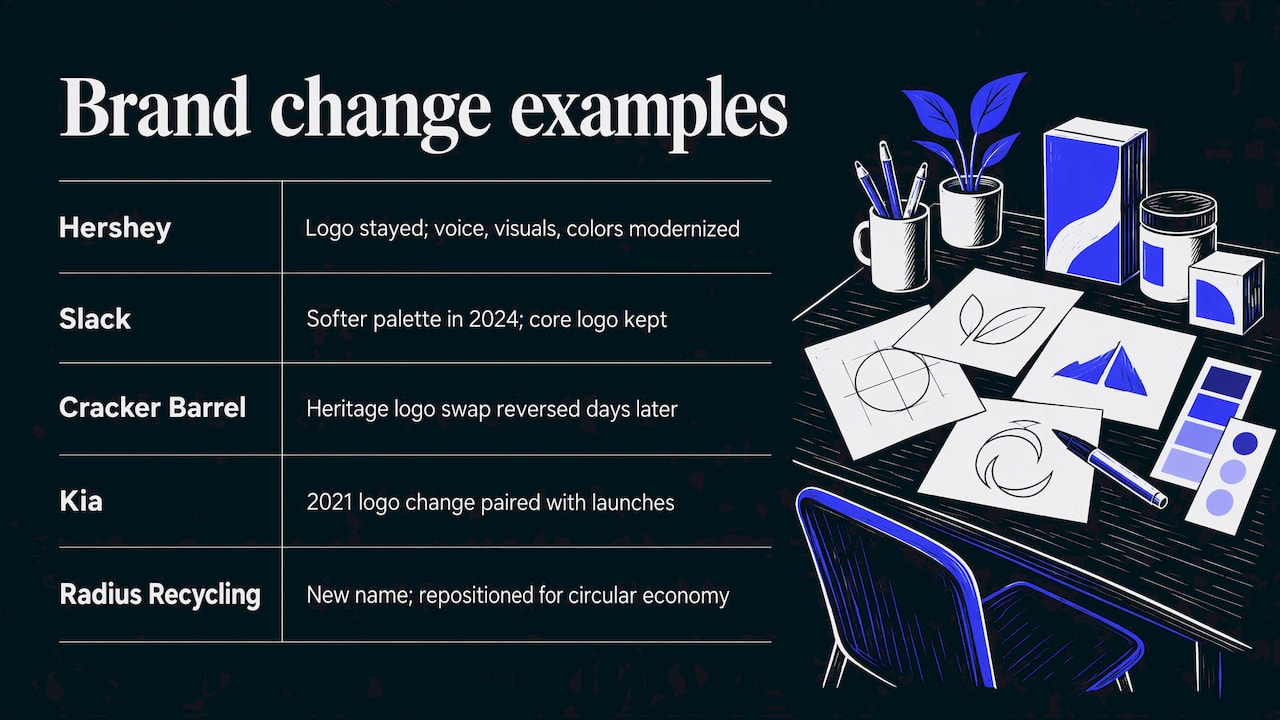
Refresh: Hershey. As above, the logo stayed while the voice, visuals and colors were modernized. The change built on recognition rather than resetting it.
Refresh: Slack. The messaging platform moved to a softer palette in 2024 while keeping a recognizable core logo, according to a 2026 brand framework write-up. That is the pattern: change the surface, protect the symbol.
Backlash: Cracker Barrel. eMarketer reports the company swapped its heritage logo for a simplified wordmark, loyal customers objected that it was abandoning its heritage, and it reversed course days later. The lesson is that a “refresh” which touches the elements loyal customers treasure most is no longer a refresh.
Welcome change: Kia. The same eMarketer piece notes that Kia’s 2021 geometric logo change generated buzz that worked in its favor because it arrived alongside forward-looking vehicle launches. The new look had something new to point at.
Rebrand: Radius Recycling. A case study describes how Schnitzer Steel changed its name and visual identity and built a new platform, repositioning the company from the steel industry into the circular economy. A new strategy, a new name and a full rollout: that is a rebrand.
Notice the Kia and Radius examples: the change was paired with something the market could see and feel, whether new products or a new story. That is where visual content does the heavy lifting.
What each path costs
Budgets vary widely by company size and scope, so treat any figure as a planning range, not a quote. GoodFirms puts refreshes at roughly $10,000 to $100,000 and rebrands at roughly $75,000 to $500,000 or more. The overlap is real: an ambitious refresh across many touchpoints can cost more than a lean rebrand for a small company.
The bigger lesson is that the design fee is not the whole bill. Once the identity exists, you pay to apply it:
- Website and landing pages
- Product or app interface
- Email templates and sales collateral
- Brand video, photography and motion graphics
- Event signage, booths and sponsor materials
- Social profiles and ad creative
- Internal documents and legal paperwork
A rename adds trademark work and, if the domain changes, a plan for redirects and search visibility. Budget for the rollout up front, or the new identity will sit half-applied.
A checklist for a refresh or rebrand
The steps are the same in both cases. The scope is what differs.
1. Audit and diagnose
Inventory every brand touchpoint, gather customer and sales feedback and review how competitors present themselves. Finish with a short list of the three to five problems that matter most. Without that list, a project drifts into taste debates.
2. Set goals and baselines
Decide what the project must change: lead volume, lead quality, win rate, event registrations, sponsor renewals. Record today’s numbers before anything launches. Without a baseline, you can never show that the work did anything.
3. Settle strategy and positioning
For a refresh, confirm the existing positioning in a page. For a rebrand, define the new one: audience, promise, personality and what you will no longer say. Get leadership sign-off here, not after the designs arrive.
4. Develop the identity
This covers the logo, color, typography, imagery style and tone of voice. Capture it in brand guidelines so that every team and vendor applies it the same way. For a rename, add legal review before you fall in love with a name.
5. Build the content that shows the brand
A new identity on a slide is abstract. A brand film, a library of on-brand photography, updated team portraits and refreshed ad creative make it concrete. Plan this early, because shoots need scripts, locations and scheduling, and they feed the website and campaigns that follow. Our guide to corporate video formats can help you decide which formats earn their place, and brand story video production shows how a brand narrative becomes a film.
6. Update the website
Your site is usually the first place a buyer checks after a recommendation. If it no longer matches the brand, the whole effort undercuts itself. Our article on when brands should redesign their websites explains the signals, and this website redesign case study shows how a redesign was tied to leads.
7. Roll out in phases
Start internally. Train sales, support and event staff, and give them short answers to customer questions about what changed and why. Then update the highest-traffic touchpoints first, such as the website, email and social profiles, before sales collateral and secondary materials. Set a timeline for retiring legacy assets so old and new do not coexist for years.
8. Announce with a reason
Explain why you changed, not only what changed. A launch that signals progress and keeps a familiar promise reads as confidence. One that offers no reason reads as instability. For a refresh, a light announcement is enough. For a rebrand, tell existing customers directly before they discover it.
9. Measure and adjust
Check results on a rhythm: shortly after launch, at 30 days and at 90 days for digital signals, then quarterly for business results.
How to tell whether it worked
“The launch went well” is not a result. Compare against the baselines you set, and track a short list of signals:
- Leads: volume and quality of inquiries, and where they come from.
- Sales: win rate and deal speed, which move slowly, so allow a few quarters.
- Search and traffic: branded search and direct visits, which tend to respond within weeks to months.
- Sentiment: what customers, partners and employees say about the brand.
- Engagement with new content: video views, watch time and social response to the refreshed creative.
For event teams, the equivalents are registration numbers, sponsor satisfaction and how far event footage travels after the day itself. Our event sponsor video deliverables guide covers how to turn event coverage into measurable value.
Common mistakes to avoid
- Treating every problem as a rebrand problem. Diagnose first.
- Refreshing the elements people love most. Protect the signature asset customers use to recognize you.
- Skipping the guidelines. Without them, the new identity drifts within months.
- Underbudgeting the rollout. Design is the visible part, and application is the expensive part.
- Launching without a baseline. You will not be able to prove results.
- Forgetting employees. Staff who cannot explain the change undermine it in every conversation.
Our perspective
We start from a simple view: a brand change is a business decision first and a creative one second. Before anyone talks about logos, we want to know what the change should do for your pipeline, your events or your sales team, because our approach emphasizes return on investment and turns creative work into leads and growth.
That is why we see the choice between a refresh and a rebrand as a question of scope, not ambition. A refresh is not a lesser project. When your positioning holds, the strongest move is often to show it better: sharper films, consistent photography, clean brand guidelines and a website that matches. When the business has truly changed, a rebrand needs even more visual proof, because a new story only lands when people can see it.
Visual content is where either path becomes real to buyers. We produce video, photography, motion graphics, ad creative, branding and website work, and we work through a nationwide network of professionals, so a rollout across several cities and events can stay consistent.
Brandon V
Put your refreshed brand on screen
Once you know the scope, the next question is how quickly your new or updated brand can show up convincingly in the market. V2 Visuals produces corporate, marketing and brand storytelling videos, corporate and marketing photography, event coverage, ad creative and custom website development, and also handles branding, logo design, visual identity and brand guidelines. Our process is built around your business goals and the return you want from the work.

If you are planning a refresh or a rebrand, start with a conversation about the content it needs. Explore our video production services, our photography services or reach us through v2visuals.com.
FAQ
How do I know if I need a brand refresh or a rebrand?
Ask whether your strategy and positioning are still valid and whether the business has fundamentally changed. If the strategy holds and only the look, tone or consistency has aged, choose a refresh. A merger, a new market, a name that limits growth or damaged reputation point to a rebrand.
How long does each one take?
A refresh is usually the shorter project, often weeks to a few months, while a rebrand with new positioning, naming and a full rollout typically runs many months. The timeline depends mostly on how many touchpoints you must update and how fast your leadership signs off at each stage.
How much does a refresh or rebrand cost?
One 2026 industry guide puts refreshes at about $10,000 to $100,000 and rebrands at about $75,000 to $500,000 or more. Your own number depends on company size, the number of touchpoints and whether you rename. Budget separately for the rollout across your website, video, photography and collateral.
Can a refresh go wrong?
Yes, when it touches the elements loyal customers value most. Cracker Barrel’s logo change drew immediate backlash and was reversed within days. Keep your most recognizable asset intact and modernize around it.
Sources
- Brand Refresh vs. Rebrand: How to Make the Right Call (GoodFirms)
- Brand Refresh: Definition, Benefits, and 6 Steps (Shopify)
- Brand Refresh vs Rebrand: Which is Best for You? (HubSpot)
- A logo too far: What separates a successful rebrand from a failure (eMarketer)
- Old Meets New: The Hershey Company’s brand refresh (The Hershey Company)
- Social Listening vs Social Monitoring (Groups Watcher)