



Professional event photography in the US generally runs about $150 to $500 per hour. Published guides put Eventbrite’s range at $150 to $400+ per hour, and corporate work usually sits above private-event pricing. Your final quote depends on the event type, your market, the photographer’s experience, the deliverables and how you plan to use the images. The hourly rate is only the starting point. Scope, turnaround and usage rights usually move the total more than the rate does.
This guide is written for event organizers, marketing teams and event sales managers who need to budget for coverage and compare quotes fairly. It covers what drives price, what a quote should spell out, how to build a shot list and checklist that protect your budget, and how to avoid the disputes that cost the most.
TL;DR
- Expect roughly $150 to $500 per hour for professional event coverage in the US, often with a 2 to 3 hour minimum. Corporate events typically price higher than private ones.
- Compare written scopes, not hourly rates: photographer count, editing, delivery speed, travel and usage rights change the total.
- Rush delivery is a separate production add-on. Same-day or 24-hour galleries commonly add $200 to $500 or more.
- A shot list built around how you will use the images prevents paying for coverage that does not produce the assets you need.
- Send the photographer your run-of-show, venue rules and intended uses before you ask for a price.
Table of Contents
- What event photography costs in the US
- What a quote should spell out
- Rush delivery and turnaround
- Pricing for government and institutional work
- How many photos should you expect?
- Build a shot list that protects your budget
- Event photography checklist before you request quotes
- Our perspective on pricing event photography
- Work with a team that plans around your goals
- How to compare two quotes side by side
- FAQ
- Sources
What event photography costs in the US
Most event photographers quote in one of three ways: an hourly rate, a half-day or full-day rate, or a package that bundles coverage and deliverables. Across the 2025 to 2026 guides we reviewed, the broad band is $150 to $500 per hour. That is a wide spread, and it is wide for good reasons.
| Factor | How it moves the price |
|---|---|
| Event type | Corporate, conference and brand work usually costs more than a private party |
| Market | Major metro areas generally cost more than smaller cities |
| Experience | Photographers who work fast in difficult light and manage VIPs charge more |
| Hours | Hourly pricing often carries a 2 to 3 hour minimum |
| Deliverables | Number of edited images, retouching and prints add cost |
| Usage | Broader commercial rights typically cost more than personal or internal use |
| Turnaround | Rush delivery is priced as an add-on |
Two things are worth remembering. First, a short event still carries pre-production and post-production work, so a low hourly rate does not automatically mean a lower total. Second, the same event can produce quotes that differ by a large multiple. That variance usually comes from what is included, not from one photographer being “better.”
Hourly rate versus day rate
Hourly pricing suits a keynote, a reception or a product launch with a defined window. A day rate is better for conferences, trade show floors and multi-room programs, where the photographer is on call from load-in to the closing session. If your event runs more than five or six hours, ask for both numbers. A day rate often works out lower per hour, and it removes the overtime question from the day itself.
What a rough budget looks like
Using the published range as a guide, here is how the arithmetic works. These are illustrations of the math, not quotes from any provider:
- A 3 hour corporate reception at $250 per hour comes to $750 before editing extras, travel or licensing.
- A 4 hour product launch at $400 per hour comes to $1,600.
- A full-day, 8 hour conference at $300 per hour comes to $2,400, and a second photographer would roughly add a second line of the same size.
Your own numbers will differ. The point is to multiply the range by your real hours, then add the line items below.
What a quote should spell out
A professional quote should state clearly what it includes. According to Peerspace’s guidance on event photography rates, buyers should confirm edited digital files, the number of photographers, travel, editing or retouching, prints, delivery platform, turnaround, overtime and image usage. Ask for each of these in writing:
- Coverage hours and overtime. What is the rate if the keynote runs 45 minutes long?
- Number of photographers. One shooter cannot cover a main stage and a sponsor hall at the same time.
- Editing standard. Color correction and culling are different from full retouching.
- Deliverables. Approximate number of edited images, resolution and file format.
- Delivery method and date. An online gallery, a shared folder, or a download link, and by when.
- Travel and expenses. Mileage, flights, parking, lodging.
- Usage rights. Which channels, for how long, and whether the license is exclusive.
- Prints. Physical prints are normally an additional cost.
Usage rights deserve the most attention
For marketing teams, usage is where surprises hide. Exclusive or broader commercial rights can raise the price. Name the real channels you need: website, social media, press, advertising, annual reports and internal communications. If you plan to run event images in paid ads next year, say so now. It is far easier to price at the start than to renegotiate after the gallery is delivered.
Rush delivery and turnaround
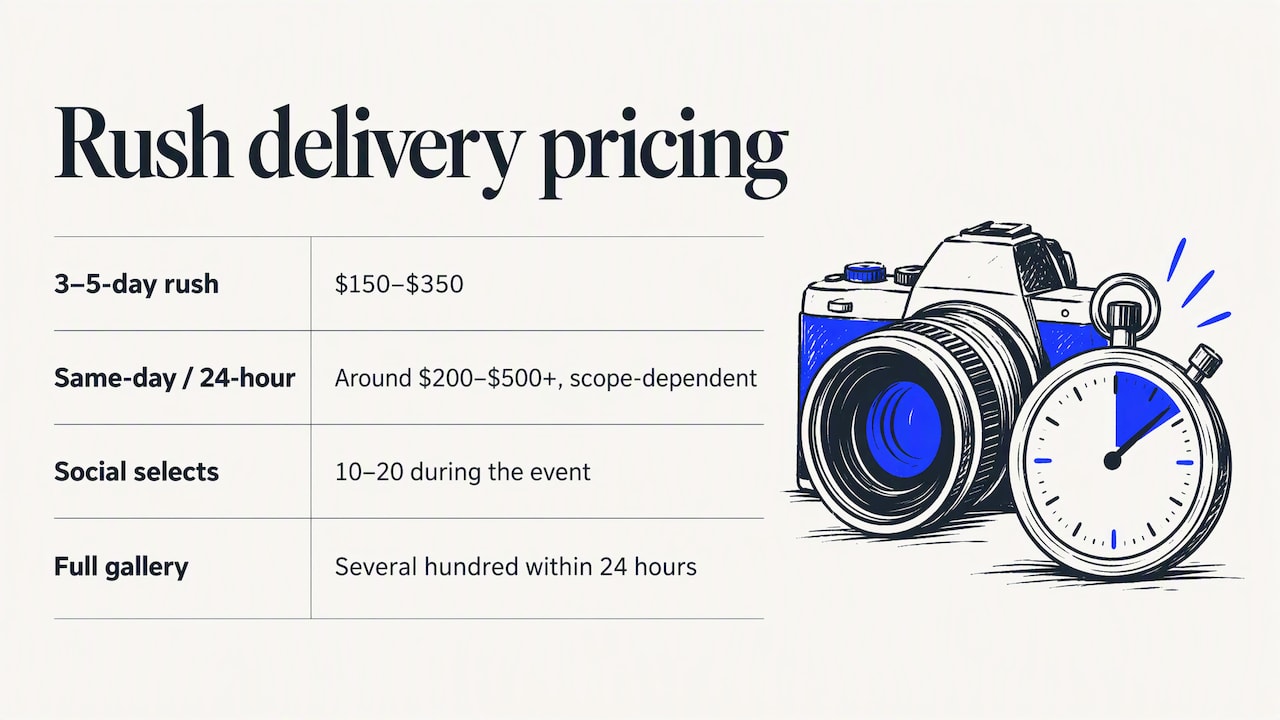
Rush delivery is a production change, not an email preference. Same-day selects require on-site culling and priority editing. According to ShootRate’s pricing guide, 3 to 5 business day rush service is listed at $150 to $350, while same-day or 24-hour delivery is commonly listed around $200 to $500 or higher depending on scope.
Be specific about what you need quickly. A small set of 10 to 20 selects for social media during the event is a very different job from a fully edited gallery of several hundred images within 24 hms. Some providers quote much larger fixed premiums for a complete 12 or 24 hour gallery. If a recap post, a press release or a sponsor update depends on speed, ask for “social selects within hours, full gallery within a week” and price those two deliverables separately.
Pricing for government and institutional work
If you buy for a public agency, a university or a nonprofit, there is no universal government rate. Pricing follows the bid and the scope. A 2026 San Juan County, Utah request for event photography covers support for approximately 20 engagement events between February and December 2026. The county’s solicitation sought a maximum fee of $4,000 for that program. An Illinois state purchasing record shows another approach, with hourly and daily rates separated for shooting, processing and delivery.
The lesson for any buyer: define the unit you are buying (per event, per day, per hour) and the minimum deliverable per event before you compare bids.
How many photos should you expect?
There is no reliable universal number of photos a photographer should take. Volume depends on event length, attendance, schedule, photographer count and editing standard. SendPhoto’s guide makes the same point: contract for coverage scope and usable deliverables, not an arbitrary shutter count. The better measure is coverage completeness: key people, important moments, branding, room scale, audience reaction, networking and required group images.
Build a shot list that protects your budget
A shot list is the cheapest way to control cost. Eventbrite’s planning guidance explains that clearly defining the images you want, the venue layout, the timeline, key people and the intended usage reduces miscommunication. It also keeps you from paying for coverage that does not produce the marketing assets you need.
Organize the list around business use, not just names. A practical corporate shot list includes:
- Venue exterior, signage and entrance
- Room setup before doors open, wide and empty
- Registration and check-in
- Sponsor booths, banners and branded displays
- Speakers, panels and moderators, from several angles
- Audience reactions and Q&A
- Networking and candid conversations
- Products or demos in use
- Awards and presentations
- Required group photos
- Closing atmosphere and departures
Add variety on purpose
The University of Illinois Extension’s guidance on event shots that always work favors a mix: landscape establishing images, groups of three to five, individual portraits, booth interactions, hands-on activity, presentation details and varied distances. That mix is more useful than repeated speaker close-ups. It also gives your team material for recap articles, social posts, sales materials and next year’s promotion.
Conference photography shot list additions
Conferences add complexity. On top of the list above, include:
- Each breakout room, with the session title visible when possible
- Keynote speaker on stage, plus a wide shot showing the audience
- Sponsor logos in context, with attendees in the frame
- Expo hall traffic at peak and quiet times
- VIP and speaker portraits in a quiet corner or at a step-and-repeat
- Evening receptions and awards
Mark each item with a priority: must-have, nice-to-have, or opportunistic. This lets the photographer decide where to be when two things happen at once.
Event photography checklist before you request quotes
Photographers can only price staffing and deliverables accurately if they have the facts. Gather these before you send a request:
- Event date, start and end times, and load-in window
- Venue name and access rules
- Run-of-show or agenda
- Expected attendance
- VIP and speaker list
- Must-have shots (your shot list)
- Lighting or flash restrictions
- Intended uses and channels
- Required turnaround
- Whether you also need prints or video
Then, on the day, confirm a single point of contact who can point out VIPs, and share the schedule changes as they happen. After the event, confirm delivery against the written scope and keep the contract with the license terms in your project folder. As one community thread on photographer pricing puts it, always get a contract.
Our perspective on pricing event photography
We shoot and edit for brands, businesses and event teams, and the most common budgeting mistake we see is comparing hourly rates instead of outcomes. Event photography only pays off when the images get used: in a recap, in a sponsor report, in next year’s registration campaign. Ben Hindman, CEO of Splash, has made the point that photography must reflect the event’s goals and potential return on investment. We agree with that.
So we start with the business question before the camera question. What will this gallery need to do? Which images does sales need? Which ones does the sponsor expect to see? When you answer those first, the quote almost writes itself, and you stop paying for frames nobody will use.
Three habits make the biggest difference to a budget:
- Decide usage up front. It is the cheapest time to negotiate rights.
- Separate fast selects from the full gallery. Rush work is real work, and pricing it separately keeps the rest of the quote honest.
- Think beyond one event. If you run a series, a consistent look and a single team across events saves briefing time and builds an image library that holds together.
Our approach is ROI-driven, and we work with a nationwide network of professionals, which matters when your events happen in several cities. If your event also needs video, we plan the photo and video coverage together so the crews are not tripping over each other or duplicating setup. For more on that side, see our guides on planning conference video and repurposing event footage.
— Brandon
Work with a team that plans around your goals
If you are budgeting for an upcoming conference, summit or corporate event, we can scope the photography with you, and video if you need it. Share your run-of-show, your intended uses and your timeline, and we will build a written scope that separates coverage, editing, delivery and usage. Learn more about our corporate and marketing photography, or start from our event photography and videography services and request a quote. Our offer pages do not list fixed prices, because the right number depends on your event’s scope.
Comparing video options as well? Our event videography costs breakdown for corporate summits explains the same scope-first logic for video.
How to compare two quotes side by side
When two quotes arrive with very different totals, line them up on the same criteria before deciding:
- Hours covered: Are both quotes for the same start and end times, including setup?
- Crew: One photographer or two? Is there backup equipment or a backup shooter if something fails?
- Edited image count: Is it a minimum, a range, or unspecified?
- Turnaround: Dates for selects and for the full gallery.
- Rights: Internal use, web and social, paid advertising, duration, exclusivity.
- Extras: Travel, overtime, prints and rush delivery.
The cheaper quote is sometimes the better value, and sometimes it simply omits things the other one lists. Compare inclusions and operational risk, not just the headline number. If a line is missing, ask. A good photographer will answer clearly and add it to the written scope.
FAQ
How much does an event photographer cost per hour in the US?
Published 2025 to 2026 guides place professional event photography at about $150 to $500 per hour. Many photographers apply a 2 to 3 hour minimum, and corporate work usually costs more than private events. Ask for a written scope so you can compare totals, not just rates.
How many photos should an event photographer take?
There is no standard number. It depends on event length, attendance, schedule, the number of photographers and the editing standard. Contract for coverage scope and usable edited deliverables, such as key people, branding, room scale and group photos, rather than a shutter count.
Is rush delivery extra?
Usually yes. Guides list 3 to 5 business day rush service at $150 to $350, and same-day or 24-hour delivery at around $200 to $500 or more. Specify whether you need a small set of social selects or a complete edited gallery, since those are priced very differently.
Is there a standard government rate for event photography?
No. Public-sector work is bid and scope dependent. One 2026 county request sought coverage of about 20 events with a maximum fee of $4,000, and a state purchasing record separates hourly and daily rates. Define the unit and minimum deliverables per event in your request.
What should I send a photographer before asking for a price?
Send the date, venue and access rules, run-of-show, expected attendance, VIP list, must-have shots, lighting or flash restrictions, intended uses, required turnaround, and whether you need prints or video. With these, the photographer can price staffing and deliverables accurately the first time.
Sources
- Event Photography Pricing: 2025 Rates for Buyers or Sellers (Eventbrite)
- Event Photography Pricing Guide (ShootRate)
- How to Craft Your Event Photography Shot List (Eventbrite)
- What You Need to Know About Event Photography Rates & Pricing (Peerspace)
- Event Photography & Documentation Consultant (San Juan County, UT)
- State of Illinois General Services Master Blanket
- Event Photography Guide: Professional Coverage Techniques (SendPhoto)
- 8 Kinds of Event Photos that Always Work (University of Illinois Extension)
- BizBash
Pingback: Commercial Photography Pricing: What Businesses Pay in 2026