



A video production brief is a short document that tells a production team who the video is for, what it must achieve, what it should look like, what it can cost and who signs off. Write it before you ask for quotes. A clear brief gets you comparable proposals, a tighter schedule and fewer revision rounds, because everyone starts from the same facts. This guide covers what to put in, who should write it, a fictional sample you can adapt and the mistakes that cause the most rework.
TL;DR
- A video brief is a roadmap of the who, what, why and how, written before production starts and tied to a business goal, not to a video format.
- One person should own it. Stakeholders give input, but a single owner holds the final direction.
- Cover the essentials: objective, audience, one key message, deliverables, distribution, budget, timeline, approvals and how you will measure success.
- Vague direction is the most common cause of delays and revision costs. Attach references and state technical requirements.
- Use the sample below as a starting point, then send it to production partners at the same time so you can compare like for like.
Table of Contents
- What a video production brief is and why you need one
- Who should write the brief
- What to include in a video brief
- A sample video production brief
- Mistakes that weaken a video brief
- Tailoring the brief to the type of project
- Our perspective: the brief is where ROI starts
- Turn your brief into a finished video
- FAQ
- Sources
What a video production brief is and why you need one
Think of the brief as the shared source of truth for the project. Storyblocks describes a video brief as a roadmap that spells out who, what, why and how before production begins, so the work lines up with business goals, brand identity, scope and success criteria.
In practice the brief does three jobs:
- It lets a production company price the work accurately. A crew can only quote what it can see. If you say “a video for our product launch,” one bidder will assume a 30-second social cut and another a three-minute brand film. The quotes will be far apart, and neither is wrong.
- It keeps your own team aligned. Marketing, sales, legal and the executive sponsor often have different pictures of the finished video. Writing it down forces those conversations to happen before the shoot day, not after the first cut.
- It gives you a standard to judge the result against. When the objective and success measure are on paper, feedback can focus on whether the video does its job instead of on personal taste.
You may see the same document called a video brief, a video creative brief, a video project brief or a production brief. The names differ, but the content is the same. A creative brief for a campaign is usually broader. A video brief narrows it down to a film or a set of films and adds the practical details a crew needs.
Who should write the brief
One person should own it. Ziflow recommends that a single owner, such as a creative director, strategist, project manager or marketing manager, holds the brief and the final direction while stakeholders contribute input. That structure prevents the common situation where five people add requests and nobody decides which one wins.
A practical way to split the work:
- The owner drafts the brief and makes the final calls on conflicts.
- Sales or product leads supply audience insight, objections customers raise and the offer.
- Brand or design supplies guidelines, logos, fonts and approved color values.
- Legal or compliance flags claims, releases, music and location restrictions.
- The executive sponsor confirms the goal and the budget range.
If you are early in planning and unsure about format, send your draft to a production partner and ask them to challenge it. A good partner will tighten the objective, point out missing technical requirements and suggest formats that fit the goal.
What to include in a video brief
Different templates group the sections differently, but they converge on the same core. Goldcast’s template covers project context and objectives, audience, core messaging, tone and brand guidelines, talent and format, deliverables, distribution, deadlines, stakeholders and approvals, and KPIs. HubSpot’s creative brief guide adds competitors, the key benefit and the attitude you want the piece to carry. A university video template from Clayton State is simpler and still includes the essentials: target audience, success metrics, style, one key message, releases and locations, key dates, placement and a call to action, plus sign-off from both client and videographer.
Here is how we would organize those into a working brief.
1. Background and objective
State the business problem in two or three sentences. “We need a video” is not a problem. “Prospects drop out after the demo because they cannot picture implementation” is. Then name the single outcome the video should drive: demo requests, event registrations, applications, internal training completion.
HubSpot also advises setting SMART goals and measurement before production, which is the right instinct. A goal like “increase registrations” is easier to evaluate when it has a number and a date attached.
2. Audience
Name the primary viewer and describe them specifically. HubSpot suggests covering demographics, behaviors, psychographics and geography, because those details shape both creative and media decisions. For a B2B video, add job title, what they already know about you, what worries them and where they are in the buying journey.
3. One key message and one next action
Pick one thing you want viewers to remember and one thing you want them to do. Every additional message dilutes both. If stakeholders insist on several, rank them and let the owner decide which survives.
4. Tone, style and references
Describe the feel in plain words (warm, documentary, polished, fast) and attach two or three reference videos with a note on what you like in each: the pacing, the lighting, the music, the way people speak on camera. Storyblocks points out that clear references help separate very different treatments such as animation versus talking-head video. Add your brand guidelines, or link to them.
5. Deliverables and formats
List every file you expect: the hero film, cutdowns, vertical versions, captions, still frames, raw footage. Give durations and aspect ratios. If the video will be used across channels, specify each one, because a 16:9 hero film and a 9:16 social edit are planned differently on the shoot day. Our guide to corporate video formats can help you decide which ones match your goal.
6. Distribution and call to action
Say where the video will live: your website, paid social, email, a conference stage, a sales deck. HubSpot notes that each channel should have an appropriate call to action. If you are also thinking about how the finished piece will travel after launch, our corporate video distribution strategy guide walks through it.
For short-form video, Adobe advises building a hook into the first three to five seconds, keeping one clear takeaway and ending with a call to action. Put that expectation in the brief so the crew plans the opening and the script accordingly.
7. Budget
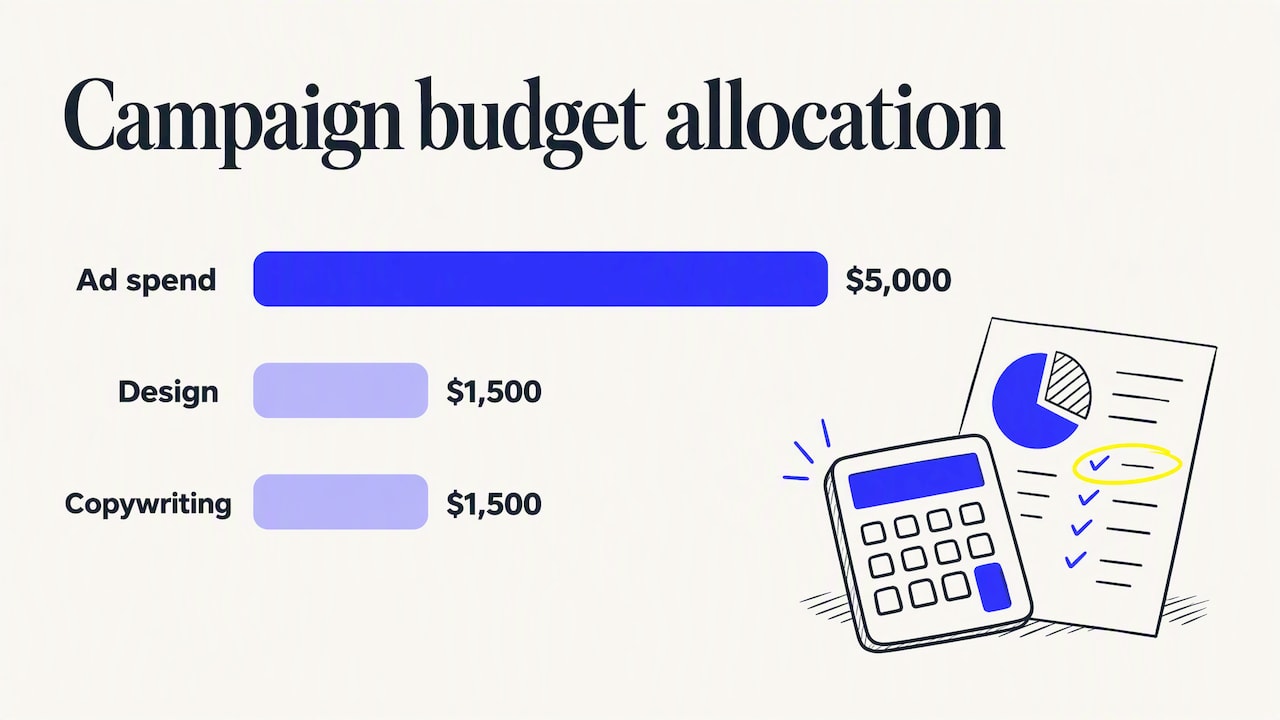
Give a real number or a range. Asana recommends stating the budget with actual figures and identifying how it is allocated. Its example splits an $8,000 campaign into $5,000 for ad spend, $1,500 for design and $1,500 for copywriting. For video, the equivalent split might separate production, post-production, talent, music licensing and paid distribution, so the production company knows how much of your total is actually available for filming and editing.
Holding the number back to “see what bids come in” usually backfires. Proposals scatter, and the discussions that follow are about money instead of creative.
8. Timeline
Asana suggests a dated timeline with milestones from kickoff through wrap-up. For video, build in these checkpoints: script or concept approval, shoot dates, first cut, feedback, final cut and delivery. Mark any fixed date, such as a conference keynote or a product launch, as non-negotiable and say why.
9. Available and missing material
List what you already have (logos, past footage, product shots, testimonials, music) and what you need created. Also list restrictions: talent releases, location permissions, competitor mentions, regulated claims and music rights.
10. Approvals and review rounds
Name who reviews, who consolidates feedback and who gives final approval. State how many review rounds are included and how quickly your team will respond. Consolidated feedback from one person is worth more than five separate emails.
A sample video production brief
The example below is fictional. It shows the level of detail that lets a crew quote and plan without a string of follow-up questions. Replace each entry with your own facts.
| Section | Sample entry |
|---|---|
| Project name | Northbeam Analytics customer story |
| Background | Mid-market prospects stall after the demo because they cannot picture rollout. Our sales team wants a proof point they can send the same day. |
| Objective | Increase demo-to-trial conversion with a customer story used in follow-up emails. Measure: trial starts from the emailed video link over the next quarter. |
| Audience | Operations directors at logistics firms with 200 to 1,000 employees. Skeptical of software promises, short on time, comfortable watching on a laptop. |
| Key message | Teams were running reports within two weeks of signing. (Confirm the figure with the customer before filming.) |
| Next action | Start a free trial. |
| Tone and references | Documentary, honest, unhurried. Reference A for interview lighting, Reference B for pacing. No stock music with lyrics. |
| Deliverables | One 2:30 hero film (16:9), two 30-second cutdowns (16:9 and 9:16), captions in English, five stills from the shoot. |
| Distribution | Sales emails, landing page, LinkedIn. Each includes a trial call to action. |
| Talent | Customer operations director and one warehouse lead. Releases required. Our team will coordinate access. |
| Locations | Customer warehouse (half-day) and our office for one interview. |
| Available material | Logo files, brand guidelines, previous testimonial audio. Missing: B-roll of the customer site. |
| Restrictions | No customer data on screens. Legal review for any numeric claim. |
| Budget | One total figure covering production and post, with music licensing listed separately. |
| Timeline | Script approval, shoot, first cut, one consolidated feedback round, final delivery, in that order, with the sales kickoff meeting as the fixed end date. |
| Approvals | Marketing manager owns the brief and consolidates feedback. VP of Sales gives final sign-off. Two review rounds. Feedback returned within two business days. |
Notice what the sample does: every row answers a question a producer would otherwise have to ask. It also stays one page. A brief that runs five pages tends to go unread.
Mistakes that weaken a video brief
Storyblocks lists the usual culprits: vague direction, missing technical requirements or distribution plans and unclear deadlines. It adds that vague direction creates misalignment, delays and revision costs. These are the ones we see most often:
- Describing a format instead of a goal. “We need a two-minute brand film” skips the question of whether a brand film is the right tool. Start with the problem, then let the format follow. A related point comes from an older industry piece, which argues that the video type should match the business problem and that customer research should inform the brief.
- Too many messages. If the video must explain the product, the company history, three features and a hiring pitch, it will do none well.
- Leaving out the budget. See above. A range is fine. Silence is not.
- No approver. When the decision maker appears only at final review, expect changes to the message at the worst possible moment.
- Missing technical requirements. Frame rates, aspect ratios, caption needs, file formats and platform specs are cheap to plan and expensive to fix.
- References without explanation. A link with no note leaves the crew guessing what you liked.
- Forgetting the footage afterward. If a live event is involved, decide up front how you will reuse the material. Our guide on repurposing event footage shows how a single shoot can feed months of content.
Tailoring the brief to the type of project
The core stays the same, but each project type needs a few extra lines.
Corporate and brand films. Add the story you want told and who will appear on camera. Executive interviews need a plan for comfort and message discipline, and our piece on filming executive interviews covers that. If the film is about your company’s origin and values, see our brand story video production page for how those projects are scoped.
Event coverage. Add the run of show, session list, speaker names, must-capture moments, sponsor deliverables and the delivery deadline for same-day or next-day edits. Our guides to planning conference video and to sponsor video deliverables list what organizers usually need. Goldcast also recommends stating whether the format is live, virtual, hybrid or prerecorded.
Recruitment video. Add who you want to attract, the roles in question and what employees are willing to say on camera.
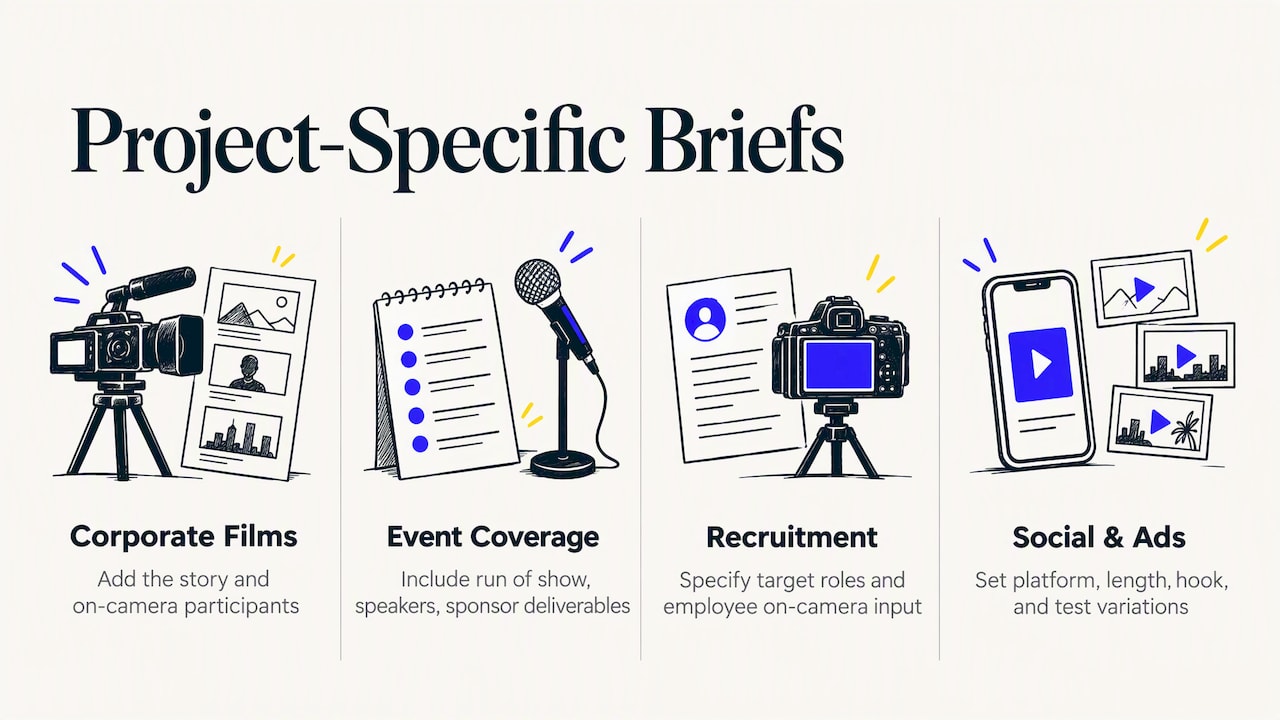
Social and ad creative. Add platform, length limits, the hook and variations to test.
Our perspective: the brief is where ROI starts
We start every project by asking what the video needs to do for the business, not what it should look like. That is why we push clients to put the objective, the audience and the measure of success at the top of the brief, before anyone discusses cameras or locations.
In our experience, the briefs that lead to the strongest work are not the longest ones. They are the ones where the owner has made decisions: one message, one next action, a stated budget, a named approver. When those are settled, our team can spend its energy on storytelling and craft, and our crews in major cities can be matched to the shoot without surprises.
We build our process around return on investment, so we like to connect each deliverable to a lead, a sale, a registration or a hire. If your brief is still rough, bring it anyway. Part of our job is helping you sharpen it into something a crew can shoot.
Brandon V
Turn your brief into a finished video
Once your brief is drafted, the next step is a conversation with a team that can challenge it and execute it. V2 Visuals produces corporate videos, marketing and brand story films, event coverage and photography for businesses across the country, with specialized crews in major cities.

Send us your draft, even if it is only half complete, and we will help you fill the gaps. Explore our corporate and marketing video production services or contact V2 Visuals to talk through your project.
FAQ
How long should a video production brief be?
One to two pages is enough for most projects. The goal is clarity, not volume. Complex productions, such as multi-day events or multi-video campaigns, can carry an appendix for run of show, scripts and technical specs, but the main brief should still be readable in a few minutes.
What is the difference between a video brief and a creative brief?
A creative brief sets strategy and direction for a campaign or a creative project in general. A video brief applies the same thinking to a film and adds production details such as deliverables, formats, locations, talent, releases and review rounds. Many teams use the two terms interchangeably, and either one works if it covers the points above.
Do I need a brief if I am hiring a production company for a small project?
Yes, a short one. Even a half-page covering the goal, audience, deliverables, budget and deadline will make quotes more accurate and speed up the kickoff. Small projects suffer the most when an unstated assumption turns into a reshoot.
Should I include my budget in the brief?
Yes. Give a figure or a realistic range and say what it must cover. Asana advises using actual numbers and showing how funds are allocated. It lets a producer propose the best approach within your means instead of guessing.
Can the production company help write the brief?
Absolutely. Many clients arrive with a goal and a deadline and little else. A good production partner will ask the questions that fill in the rest. It still helps to name an internal owner so the answers come from one voice.
Sources
- Your guide to writing great video briefs, Storyblocks
- Improve collaboration with this free video brief template, Ziflow
- Video Creative Brief Template, Goldcast
- Creative Brief, Clayton State University
- How to Write a Creative Brief in 11 Simple Steps, HubSpot
- 8 Questions to Help You Write a Compelling Marketing Brief, HubSpot
- Creative Briefs: What To Include, Asana
- How to make short videos, Adobe
- Conquering The Creative Brief For Video, invidis