



Most professional business videos in the United States cost somewhere between a few thousand dollars and the low six figures. The spread is wide because you are not buying a file. You are buying people’s days: planning, a crew on set, and editing time. A lean interview video and a multi-location commercial are different jobs at different price points.
This guide explains where the money goes, what typical budget tiers look like, and how to scope a project so the quote you get matches the result you need. We are a production company, so we will also say plainly where we cannot give you a number without knowing more.
TL;DR
- Cost follows shoot days, crew size, talent, locations and edit days. Video length matters far less than most buyers expect.
- Published guides commonly place simple business videos in the low thousands, polished corporate and marketing videos in the five-figure range, and broadcast-style commercials higher. Treat every range as a starting point, not a quote.
- A 30-second TV commercial has two bills: production and airtime. Airtime is often the larger one.
- AI tools have lowered the price of some formats, but human direction still decides whether a video is distinctive enough to work.
- The fastest way to a reliable number is a short brief: goal, audience, where the video will run, and how many finished versions you need.
Table of Contents
- What you are actually paying for
- Typical price ranges by video type
- What does a 30-second commercial cost?
- Corporate and promotional video budgets
- How AI is changing video production costs
- Where a smart budget goes and where it gets wasted
- How to get a quote you can compare
- Our perspective: price the outcome, not the minute
- Plan your video with V2 Visuals
- FAQ
- Sources
What you are actually paying for
Every video budget splits into three phases. Understanding them makes quotes easier to compare.
Pre-production covers strategy, concept, scriptwriting, storyboards, casting, location scouting and scheduling. It is the cheapest phase per hour and the one that saves the most money later. Unplanned shoots run long, and a crew on set is the most expensive time in the project.
Production is the shoot itself: director, camera operators, sound, lighting, grip, producer, makeup, talent, locations, permits and equipment. Day rates for each role stack up, which is why crew size is the biggest lever on price.
Post-production covers editing, color, sound mixing, music licensing, motion graphics, captions, and exports for each platform. Revisions live here too, so a clear approval process protects your budget.
The factors that move the price most
- Shoot days. Half a day with a small crew and three days across two cities are not the same product.
- Crew size. One shooter and a sound operator suit a leadership interview. A commercial often needs a full department structure.
- Talent. Employees and customers cost nothing in fees but need coaching time. Professional actors, voiceover artists and on-camera hosts add fees and usage terms.
- Locations and permits. Your own office is the cheapest set. Studios, rented venues and public locations add rental, insurance and permit costs.
- Post-production complexity. Motion graphics, animation, visual effects and multiple cutdowns add edit days.
- Deliverables. One hero film plus six social cutdowns, captions and a vertical version is more work than a single export. It is also usually better value per asset when planned together.
- Usage and licensing. Paid media, broadcast and long-term usage can raise talent and music costs.
Typical price ranges by video type
Published US pricing guides vary, and no two agree exactly. The ranges below reflect the general pattern you will see across those guides and the way budgets tend to tier. They are orientation, not a price list. Our own prices are scoped per project, and we do not publish fixed rates.
| Video type | Typical budget pattern | What drives it |
|---|---|---|
| Social and short-form content | Low thousands per batch | Number of cutdowns, captions, shoot days |
| Talking-head or executive interview | Low to mid thousands | Crew size, set, editing and B-roll |
| Corporate or explainer video | Mid thousands to the five-figure range | Script, interviews, motion graphics |
| Brand film or story video | Five figures and up | Concept, locations, cinematography, music |
| Animated video | Varies widely by style | Illustration, rigging, voiceover, length |
| Broadcast-style commercial | Often the highest tier | Cast, crew, locations, usage rights |
| Event coverage | Scales with hours and deliverables | Crew count, number of sessions, turnaround |
If you want a Los Angeles-specific view of how corporate pricing is structured, we break it down in our guide to corporate video pricing in Los Angeles. For animation, what animated video pricing really covers explains why two animated quotes can differ by a factor of five.
Budget tiers in plain terms
It helps to think in three tiers rather than a single average.
- Lean. One or two crew members, one location, simple lighting, a straightforward edit. Right for testimonials, leadership messages, internal updates and social content where authenticity matters more than polish.
- Mid-range. A small full crew, a scripted or structured interview approach, planned B-roll, a custom graphics package and two or three deliverables. This is where most corporate and marketing videos land.
- Premium. A directed shoot with a larger crew, multiple locations, professional talent, advanced lighting and camera packages, and a long post-production schedule. Brand films and commercials sit here.
None of these tiers is automatically better. The right one is the one that matches the audience’s expectations and the video’s job.
What does a 30-second commercial cost?
Buyers searching for the cost of a commercial are usually mixing two separate numbers.
Production cost is what it takes to make the spot: concept, script, cast, crew, locations, edit, music and finishing. For a professionally produced 30-second ad, published guides generally put this well above a typical corporate video, because the shoot is compressed and every second is heavily crafted. A simple local spot with a small crew can be far cheaper than a spot with cast, multiple locations and special effects.
Media cost is what it takes to air it. Airtime depends on the market, the daypart and the network. Local cable in a small market and a national prime-time slot are in entirely different categories. Budget for media separately, and decide it before you set the production budget, because it determines how polished the creative needs to be and how many cutdowns you need.
If your goal is lead generation rather than broadcast awareness, you may not need a commercial at all. A focused set of short videos built for the channels where your buyers actually watch can cost less and be easier to measure. Our overview of corporate video formats that support growth can help you choose.
Corporate and promotional video budgets
Corporate and promotional videos cover a lot of ground: company overviews, product explainers, recruiting videos, customer stories, and campaign assets. The best way to set a budget is to work backward from what the video must do.
- A company overview for a sales team needs strong interviews and clean visuals. Cost depends on how many people appear and how many locations you shoot.
- A product or service explainer often needs motion graphics or screen capture, which shifts cost from the shoot to post-production.
- A customer story is usually efficient: one customer location, one interview setup, and B-roll of the product in use.
- A promotional campaign has the most variables. The hero video is only part of the cost. Cutdowns, platform versions and ad variations are where the real volume sits.
Plan the family of deliverables up front. Shooting once and editing many versions is almost always cheaper than commissioning each video separately.
Event video budgets
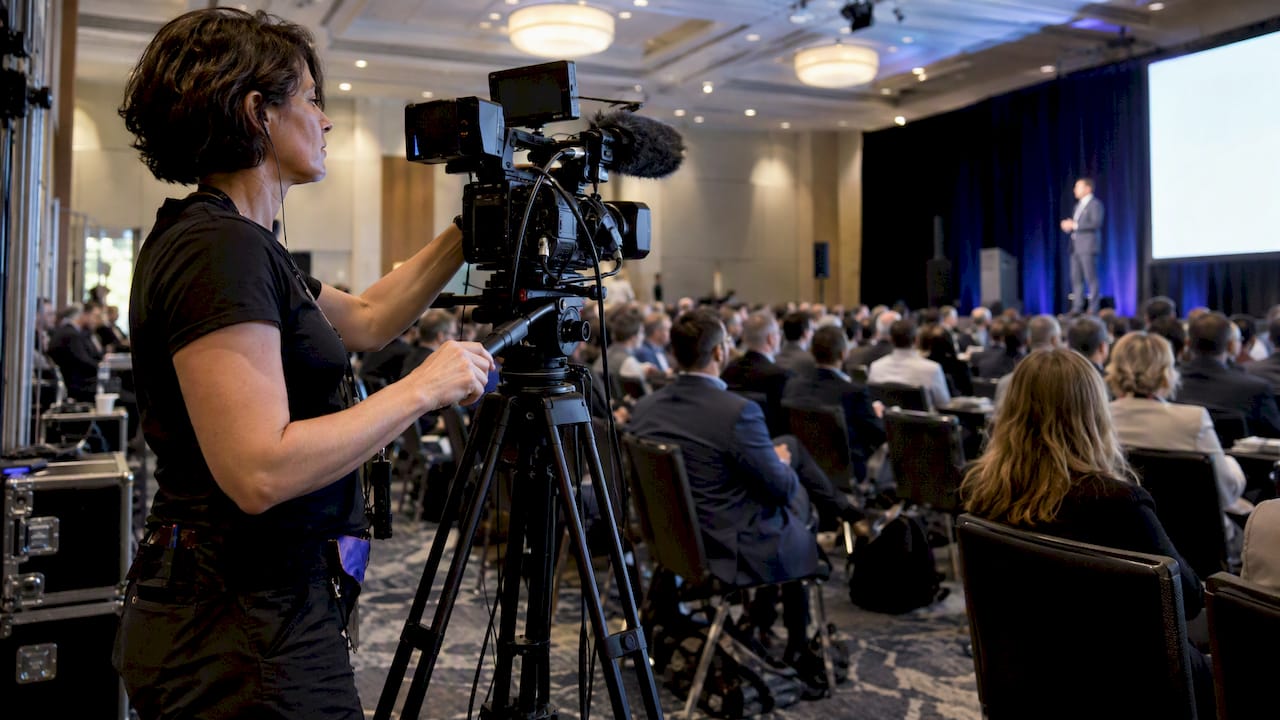
Event coverage works differently because you cannot reshoot the keynote. Cost scales with how many hours you need covered, how many cameras and operators, how many rooms run at once, and how quickly you need highlights. Sales and marketing teams get far more from event footage when they plan reuse before the day. Our guide on repurposing event footage shows how one event becomes months of content.
How AI is changing video production costs
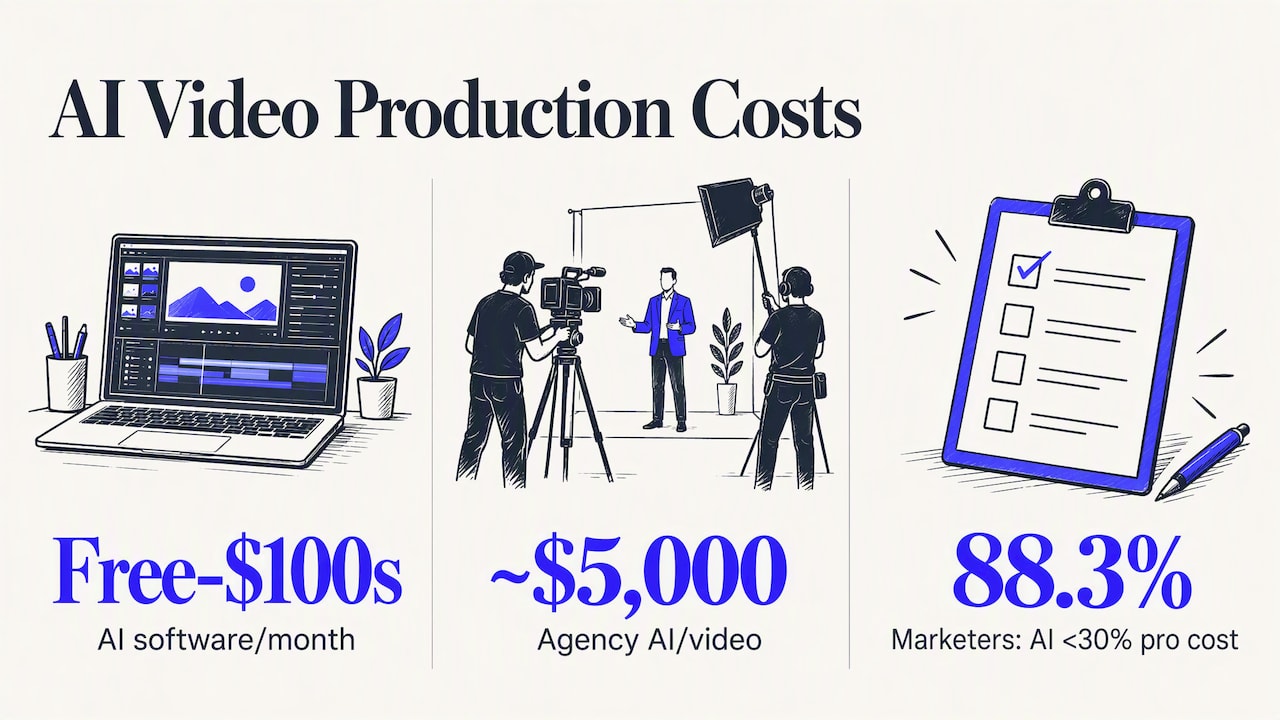
AI has changed the economics of some video work. A GoodFirms analysis of AI versus professional video production reports that self-service AI software can cost between nothing and a few hundred dollars per month, while agency-managed AI-assisted production starts at roughly $5,000 per video. In the same research, 88.3% of marketers said AI video cost less than 30% of professional production.
Those savings are real for certain formats: quick explainers, social variations, translations and internal content. They come with trade-offs. An American Marketing Association summary of a Journal of International Marketing study found that consumers can rate AI-translated marketing videos differently from human-translated ones, which is a reason to keep human review on anything sensitive or high-stakes.
There is a larger point as well. Reporting from Advertising Week New York 2026 describes a market where the cost of producing competent marketing material keeps falling, while audience attention does not grow. In that environment, a video that looks competent is no longer enough. Distinct ideas and real people are what stand out. That is where directed, human-led production still earns its fee.
Where a smart budget goes and where it gets wasted
After enough projects, patterns repeat. Here is where budgets tend to be well spent:
- Pre-production time. A tight script and shot list cut shoot days.
- Audio. Viewers forgive imperfect visuals before they forgive poor sound.
- Planning for reuse. Capturing vertical and horizontal framing, extra B-roll and standalone quotes pays off in the edit.
- One decision-maker. Feedback from five people with no hierarchy creates revision rounds that cost days.
And where they tend to leak:
- Last-minute script changes after the shoot.
- Adding locations or talent because “we are already there.”
- Undefined revision limits.
- Buying a premium look for a video that will be watched on a phone for twenty seconds.
Editing is its own line item and often underestimated. If you already have footage, our video editing pricing guide explains what drives editing quotes.
How to get a quote you can compare
Give every production company the same information, and the quotes become comparable. A good brief includes:
- The goal. Leads, brand awareness, recruiting, training, event promotion.
- The audience. Who will watch, and where.
- The channels. Website, paid social, sales decks, broadcast, event screens.
- The deliverables. Length, number of versions, aspect ratios, captions.
- The assets you already have. Brand guidelines, logos, existing footage, scripts.
- The timeline. Rush schedules usually cost more.
- The budget range. Sharing it lets a producer propose the best option within it rather than guess.
Then compare quotes line by line: crew, shoot days, edit days, revisions, music licensing, and usage terms. The cheapest quote often leaves out items that appear later as change orders.
Our perspective: price the outcome, not the minute
We approach cost from the business result backward. A video that costs less but never generates a lead is the expensive one. We start every project by asking what the video must achieve and who must see it, then we build the crew, schedule and deliverables around that answer.
Our work spans video production, event videography, photography, motion graphics, animation and ad creative, so we can often fold several needs into one planned shoot. That is where budgets stretch furthest: one crew, one day, a full library of assets. With a network of professionals across the country, we can also staff shoots in major cities without charging you to fly a single crew everywhere.
We would rather scope a smaller project well than sell a larger one that your team cannot use. If the right answer is a simple interview shoot, we will say so.
— Brandon V
Plan your video with V2 Visuals
If you are building a budget for a corporate, marketing or event video, we can help you scope it. Tell us your goal, audience and timeline, and we will propose a crew and deliverables that fit. Explore our corporate, marketing and brand video production services, or start from our main site to discuss event videography, photography and ad creative. If your project is mostly about telling a brand story, brand story video production is a good place to begin.
FAQ
How much does it cost to produce a 3-minute video?
Length is only one factor. A three-minute interview-driven video with a small crew can cost far less than a three-minute animated or multi-location film. The number of shoot days, the amount of graphics work and the cast are what set the price. Share your script or outline to get a firm quote.
Is a more expensive video always better?
No. A higher budget buys more crew, better equipment, more locations and more polish, but the best video is the one that fits the audience and channel. A candid customer testimonial on a lean budget can outperform a glossy film that feels generic.
Can I lower my video production cost without losing quality?
Yes. Shoot multiple videos in one session, reuse footage across formats, finalize your script before the shoot, limit locations and name one approver. These choices reduce crew days and revision rounds, which are the largest cost drivers.
Does AI make professional video production unnecessary?
For some formats it lowers cost, particularly social variations and quick explainers. For brand films, executive messages and anything where trust and originality matter, human direction and review remain important. Many teams use AI inside a professionally planned production rather than instead of one.
Sources
- GoodFirms: AI vs. professional video production cost
- American Marketing Association: What do international consumers think of AI-translated videos?
- AW360: Advertising Week New York 2026 finds the industry moving past the hype