



A website redesign in the United States can cost anywhere from a few thousand dollars to well over $100,000. The spread is wide because “redesign” covers very different projects: a visual refresh on your current platform, a full rebuild with migration, or a custom corporate platform. For most professionally built business sites, plan on roughly $15,000 to $75,000, then add the line items most quotes leave out.
This guide explains where the money goes, how to compare proposals fairly, and how to build a budget your finance team can approve.
TL;DR
- Published U.S. guides put redesigns at about $100 to $3,000 for DIY, $2,000 to $20,000+ for freelancers, and $15,000 to $30,000+ for agencies, with large, complex sites reaching $40,000 to $75,000+ (HubSpot).
- Scope, not page count, drives price: integrations, approval workflows, content readiness and custom templates move the number most.
- Budget separately for content, photography, video, SEO migration, accessibility and the first year of running costs.
- Compare quotes on what they include, not on the total.
- Treat SEO as a migration project from day one, not a launch-day task.
Table of Contents
- What a website redesign actually costs
- What drives the price up or down
- Budgeting a corporate website redesign
- Costs most budgets miss
- How long a redesign takes
- How to compare redesign quotes
- Protecting your SEO during a redesign
- Our perspective: budget for the assets, not only the template
- Where V2 Visuals fits
- A simple way to set your budget
- FAQ
- Sources
What a website redesign actually costs
Published guides disagree, and they should. One 2026 guide lists a range of $3,000 to $160,000+, another $10,000 to $200,000+. Those are planning ranges, not market averages, because each source prices a different mix of projects and provider types.
Here is a practical way to read the bands for a U.S. business:
| Project type | Typical planning range | What you usually get |
|---|---|---|
| DIY or website builder | $100 to $3,000 | Template, your own content, your own time |
| Freelancer | $2,000 to $20,000+ | One designer or developer, limited strategy and QA |
| Agency (small to mid-size site) | $15,000 to $30,000+ | Strategy, design, development, project management, QA |
| Large or complex site | $40,000 to $75,000+ | Custom templates, integrations, migration |
| Enterprise platform | $100,000 to $250,000+ | Multi-site, multilingual, governance, security |
The first four rows follow HubSpot’s redesign cost breakdown. For broader context, Shopify’s website cost guide cites $1,000 to $145,000 per project across all approaches.
Agencies cost more than freelancers because they bundle strategy, design, development, project management, QA and often SEO under one contract. You are paying for coordination and accountability as much as for pixels.
What drives the price up or down
Two sites with 40 pages can differ by $50,000. These are the factors that explain it.
Site type and complexity
A brochure site with standard templates is a different job from a corporate site with careers, news, investor and product sections. Each unique template, filter, gated asset and form adds design and development hours.

Integrations
Connecting your CRM, marketing automation, scheduling tools or a product database means engineering and testing. Integrations are one of the most common reasons a quote grows after kickoff.
Stakeholders and approvals
Every additional approver adds review rounds. Corporate teams with legal, brand, IT and regional sign-off should expect longer timelines and a larger project management line.
Content readiness
If your copy, imagery and product details are not ready when design starts, the schedule slips and the cost follows. Content preparation and approvals are among the most frequent schedule constraints on redesigns.
Platform change
Staying on your current CMS is cheaper than moving to a new one. A replatform adds content migration, redirect mapping and retraining.
Accessibility and security
Building accessibility into discovery and acceptance criteria costs less than retrofitting it. More on that below.
Budgeting a corporate website redesign
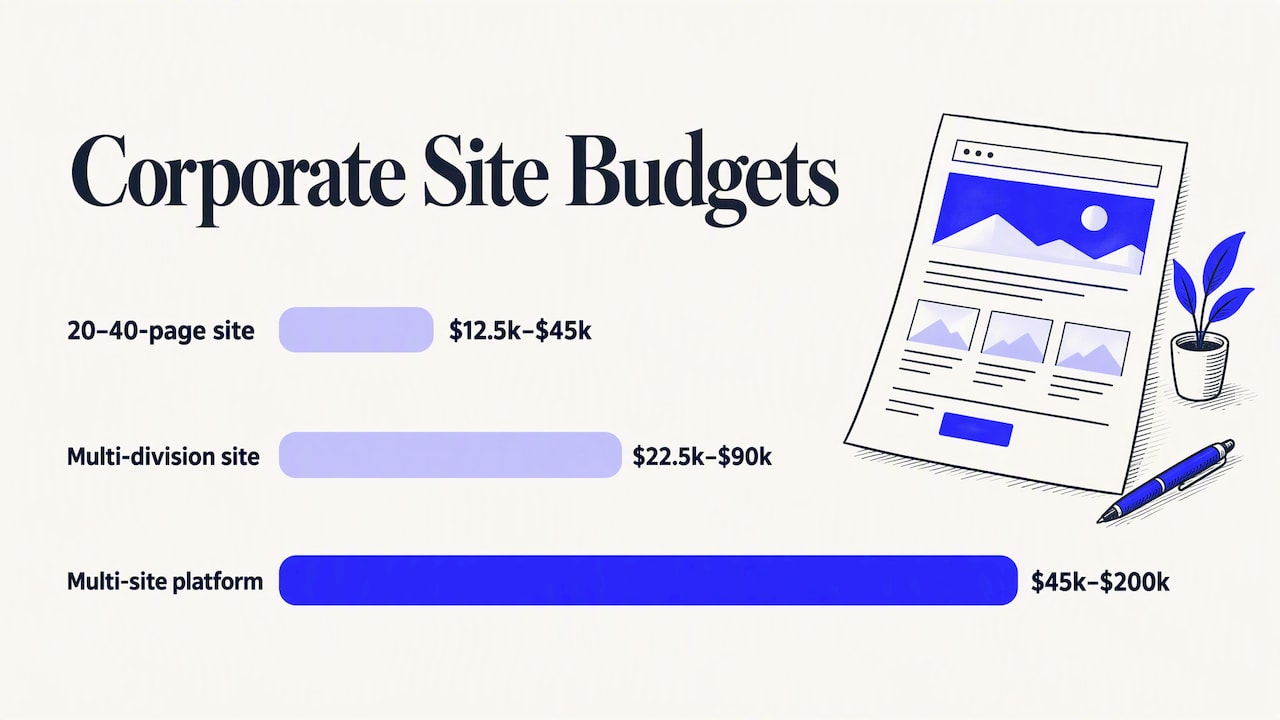
Corporate sites deserve budgeting by operating complexity, not by how they look. Published 2026 estimates place a 20 to 40 page corporate site around $12,500 to $45,000, a multi-division site around $22,500 to $90,000, and multilingual or multi-site platforms around $45,000 to $200,000, according to a corporate website cost guide. Treat these as starting points for conversation, not quotes.
Before you request proposals, write down:
- Who the site serves: buyers, investors, candidates, press, existing customers.
- Who must approve the work, and how many review rounds you can realistically run.
- Which systems must connect: CRM, marketing automation, analytics.
- Whether you need more than one language or more than one brand.
- How many pages will move over unchanged and how many need new writing.
That list alone will tighten the proposals you get back.
Costs most budgets miss
The design and development fee is not the whole investment. Add these lines before you set the final number.
Content and creative assets
New copywriting, photography and video often sit outside a standard web design quote. A homepage that relies on stock images and a text-only story rarely performs like one built on original assets. If your site needs a brand film, team and executive portraits, product photography or short animated explainers, scope them as their own deliverables with locations, crew, usage rights, editing rounds and cutdowns spelled out. This is where we spend most of our time with clients; see our corporate video production and corporate photography work.
SEO migration
If URLs, templates or site structure change, you are doing a migration. HubSpot’s migration checklist explains why: the goal is preserving accumulated rankings, backlinks and user pathways, not just avoiding 404 pages. Budget for a URL inventory, redirect mapping, staging tests and post-launch monitoring.
Hosting, apps and maintenance
These costs continue after launch. Forbes Advisor notes that hosting and apps for small businesses commonly run $15 to $150 per month, and that maintenance, plug-ins and similar extras add to the total. Compare the first-year and three-year cost of ownership, not just the proposal total.
Accessibility
WCAG conformance affects content structure, keyboard behavior, color contrast, forms and media alternatives. Public entities face specific federal rules under the ADA: 28 CFR 35.200 sets WCAG 2.1 Level AA requirements for state and local governments, and 45 CFR 84.84 covers certain federally funded recipients. The Department of Justice extended the Title II compliance deadlines in April 2026, so check current dates. If you are a private company, ask your counsel whether any of these rules or your contracts apply to you. Either way, write accessibility into the brief so every bidder prices it.
How long a redesign takes
Time is a cost. Rough benchmarks from current professional guides:
- 2 to 4 weeks: template refresh or tightly scoped project.
- 4 to 12 weeks: professional marketing or small-business redesign.
- 2 to 5 months: mid-market site with content migration and integrations.
- 5 to 14 months: complex enterprise platform.
These are benchmarks, not promises. Your timeline depends mostly on how quickly your team delivers content and signs off on each phase.
How to compare redesign quotes
Two proposals with the same total can cover very different work. Ask each provider to state, line by line, whether the price includes:
- Discovery and strategy
- UX and wireframes
- Visual design
- Copywriting
- Photography and video
- Development and CMS setup
- Content migration
- SEO migration and redirects
- Analytics and conversion tracking
- QA and accessibility testing
- Training
- Hosting and post-launch support
Then ask what happens when scope changes, how many revision rounds are included, and who owns the files and code at the end. A cheaper quote that leaves out half this list is usually the more expensive one.
Protecting your SEO during a redesign
The costliest redesign mistake is treating SEO as a launch task. A site can launch cleanly and still lose traffic if search engines meet broken redirects, changed URLs or conflicting canonical signals. Pantheon’s migration checklist recommends this sequence:
- Before development, inventory URLs from a crawl, analytics, Search Console and backlinks.
- Map every changed URL to its closest relevant new page.
- Test redirects, canonicals, robots rules, internal links and the XML sitemap on staging.
- Use permanent server-side redirects, pointing directly to the destination without chains.
- Update internal links rather than relying on redirects alone.
- Record baseline traffic and rankings, then monitor after launch.
The same checklist notes that Google’s guidance recommends keeping migration redirects in place for at least a year. Expect a temporary ranking fluctuation while pages are recrawled.
Our perspective: budget for the assets, not only the template
We are a video and photo production company that also builds websites and apps for brands, so we see redesigns from the content side. The pattern is consistent: companies spend six figures on structure and design, then fill the pages with stock imagery and a thin story. The site looks new, but it does not convert any better.
Our view is that a redesign budget should start from the business outcome, whether that is more qualified leads, shorter sales cycles or stronger recruiting, and work backward. That is how we approach every project: strategic creative work filtered through results. If a homepage needs a two-minute brand film, executive portraits and a set of short cutdowns for paid social, those assets should be planned in discovery, not squeezed in after design is locked.
We would rather you ask hard questions of any provider, including us. What will this change in leads? Which pages carry the revenue? What does the site need to show that words cannot? You can see how we think about timing in when brands should redesign for growth and what a redesign can do in our traffic-to-leads case study.
— Brandon
Where V2 Visuals fits
We offer custom website and app development alongside video production, photography, motion graphics and ad creative, so your redesign and your content can be planned as one project. We do not publish fixed prices, because scope varies too much; we scope each engagement around your goals, deliverables and audience.
If you are planning a redesign and want to know what the visual assets should look like, start with our website, motion graphics and ad creative services, or contact us through our main site for a scoping conversation.
If video is on your list, two of our guides explain the cost side: what animated video pricing really covers and which corporate video formats work best.
A simple way to set your budget
- Define the outcome. Pick one or two measurable goals, such as demo requests or qualified applications.
- Audit what you have. Identify the pages that earn traffic and revenue, and the content that is outdated.
- Choose your tier. Use the table above to pick a realistic provider type for your complexity.
- Add the extras. Include content, photo and video, SEO migration, accessibility testing and first-year running costs.
- Keep a contingency. Reserve a portion of the total for scope changes, since approvals and integrations are where budgets stretch.
- Request itemized proposals. Use the checklist above so quotes can be compared like for like.
HubSpot’s migration guide notes that web design experts often recommend a redesign every two to three years, which can sometimes be a simple facelift rather than a full rebuild. Planning for a smaller refresh cycle can keep each project cheaper than a once-a-decade overhaul.
FAQ
How much does a website redesign cost for a small business?
A small-business redesign typically falls between about $3,000 and $15,000 for template-led work, and about $15,000 to $30,000+ with an agency. Final cost depends on page count, content readiness and integrations. Ask for an itemized quote so you know what is included.
How much should I budget for a corporate website redesign?
Corporate sites with multiple divisions, approval layers and integrations often land in the tens of thousands, and multilingual or multi-site platforms can exceed $100,000. Start by listing audiences, systems and approvers, then collect itemized proposals. Include content, SEO migration and the first year of hosting and maintenance.
Is a freelancer cheaper than an agency?
Generally, yes. Freelancer projects commonly sit below agency projects because one person handles the work. Agencies cost more because they add strategy, project management, QA and often SEO, which matters on larger or more complex sites.
Will a redesign hurt my search rankings?
It can if URLs change without a plan. Inventory your URLs, map redirects, test on staging and monitor after launch. Some temporary fluctuation is normal while Google recrawls the site.
Do I need to budget for photography and video?
If you want original imagery and brand storytelling, yes. These are usually separate from the design fee and should be scoped with locations, crew, editing rounds and usage rights. Planning them early keeps the design and the assets consistent.
Sources
- What Does It Cost to Redesign a Website? (HubSpot)
- How to Successfully Migrate a Website Without Harming SEO (HubSpot)
- A Phase-by-Phase SEO Website Migration Checklist (Pantheon)
- How Much Does a Website Cost? (Forbes Advisor)
- How Much Does a Website Cost in 2025? (Shopify)
- How much does a corporate website cost? (Billion Web Studio)
- 28 CFR 35.200, Requirements for web and mobile accessibility (eCFR)
- 45 CFR 84.84, Requirements for web and mobile accessibility (eCFR)
- DOJ extends public entities’ ADA website accessibility deadline (Jackson Lewis)