


Motion graphics move design elements such as text, icons, charts and logos to explain something clearly. Animation, in the broader sense, brings characters, scenes and stories to life frame by frame. If your goal is clarity, data or brand polish, motion graphics usually fit. If your goal is emotional connection through a story, animation usually fits. Most business video programs end up using both, and often live action too.
This guide is written for marketing teams, brand managers and event organizers who have to pick a format, brief a production partner and defend the budget. It covers the practical differences, the 2D vs. 3D question, where live action wins, and a simple way to decide.
TL;DR
- Motion graphics animate graphic elements to communicate information or brand identity. Animation is the umbrella term, and in marketing it usually means story-led, character-driven work.
- Choose motion graphics to explain a process, visualize data or add polish to existing footage. Choose animation to build emotion, show something that cannot be filmed, or carry a long story.
- 2D is typically the simpler and faster build. 3D adds modeling, rigging and rendering, which is why it suits products, spaces and systems that need depth.
- Live action wins on trust, people and real places. The strongest campaigns often layer motion graphics over live-action footage.
- Decide from your goal, audience and update cycle first, then match the technique to the budget.
Table of Contents
- What is the difference between motion graphics and animation?
- Why the distinction matters for budget and timeline
- 2D vs. 3D animation: which one fits your message?
- Motion graphics vs. live action
- How to decide: a five-question checklist
- Our perspective: start from the business outcome, not the technique
- What about AI and hiring?
- Briefing your production partner
- Work with V2 Visuals
- FAQ
- Sources
What is the difference between motion graphics and animation?
Animation is the larger category. It covers character animation, stop motion, hand-drawn work, 3D worlds and, yes, motion graphics. Motion graphics focus on animating elements such as text, icons and shapes to communicate information, data or brand identity, while animation in the narrower sense means character-driven storytelling and frame-by-frame performance.
Adobe describes motion graphics simply as graphics with movement, a technique that emerged in the mid-20th century and changed a discipline that had previously centered on static graphics.
The easiest way to separate them is by purpose:
- Motion graphics answer the question “how does this work?” or “what do these numbers mean?”
- Story animation answers “how should the audience feel about this?”
Coursera makes a similar distinction: motion graphics are animation without a narrative, using self-contained movement to convey information or emotion.
Side-by-side comparison
| Factor | Motion graphics | Story-led animation |
|---|---|---|
| Main job | Explain, clarify, brand | Tell a story, build emotion |
| Typical content | Text, icons, charts, logos, interfaces | Characters, environments, scenes |
| Works with live action | Often overlaid on footage | Usually standalone |
| Production effort | Lighter, reusable assets | Heavier, built from scratch |
| Easy to update | Yes, swap text, data or colors | Harder once production starts |
| Best for | Explainers, data, product UI, social ads, lower thirds | Brand stories, character campaigns, concepts that cannot be filmed |
Why the distinction matters for budget and timeline
Motion graphics generally offer a faster turnaround and lower cost than full character animation, because they lean on simpler design systems and fewer unique assets that are easy to modify. They also tend to be built around reusability inside a broader visual identity system. Narrative animation is typically built from scratch for one story, so it is more rigid once production begins.
That has real consequences for a marketing team:
- If your messaging changes quarterly, a motion graphics system with swappable text, numbers and colors saves repeated production costs.
- If you are producing one flagship story, a custom animation is an investment in a piece that will stay relevant for a long time.
- If you need dozens of cutdowns for ads and social, a motion graphics template built on your brand guidelines is the more practical path.
We cover what drives animation quotes in more detail in our guide to what animated video pricing really covers.
The technical difference in plain language
Motion graphics are rarely standalone pieces. They are frequently designed to sit on top of live-action footage or web interfaces, so the workflow centers on transparency, alpha channels and compositing. Full-scene character animation renders entire worlds instead. In practice that means a motion graphics artist and your video editor work in the same timeline, while a character animation project has its own pipeline of storyboards, design, animation and rendering.
2D vs. 3D animation: which one fits your message?
This is the question behind many searches, and it is a style choice inside animation, not a rival to motion graphics. Motion graphics can be 2D or 3D too.
2D animation works on a flat plane. It is the common choice for explainers, illustrated brand stories and social content. It reads quickly, it is forgiving of abstract ideas such as software, finance or services, and it generally has fewer production stages.
3D animation adds depth. According to Autodesk, 3D animation adds movement to static 3D models, using rigging, a digital skeleton, so animators can define motion through keyframing and related techniques. Those extra stages of modeling, rigging, lighting and rendering are why 3D normally costs more and takes longer than 2D for the same running time.
| Choose 2D when… | Choose 3D when… |
|---|---|
| You are explaining a service, workflow or idea | You need to show a physical product from every angle |
| You want a distinctive illustrated style | You need to show a space, machine or system in cutaway |
| Your timeline or budget is tight | The video will be reused across launches and trade shows |
| You expect frequent script changes | The visuals must feel premium and realistic |
A useful rule: if the audience needs to understand a concept, start with 2D. If they need to understand an object, consider 3D.
Motion graphics vs. live action
Live action means footage of real people and places, shot with a camera. Wikipedia notes it is the most common form of cinematography and videography, and marketing bears that out: in one 2025 summary, 51% of video marketers focus primarily on live action, while 23% primarily create animated videos.
The two are not competitors so much as ingredients. Here is how they differ in practice:
- Live action builds trust. Customer testimonials, executive interviews, factory floors and event footage show real people. Nothing replaces a face for credibility.
- Motion graphics add meaning. Animated lower thirds, statistics, process diagrams and branded transitions turn raw footage into something a viewer can follow with the sound off.
- Animation covers what cameras cannot. Internal software processes, molecular science, future products or abstract services are easier to show drawn than filmed. Animation also gives creators control over every element of the frame, which live action cannot match.
For most B2B teams the winning formula is a live-action core with motion graphics layered on top, plus an animated segment where the idea is abstract. Our write-up of corporate video formats that support growth shows how those pieces fit together across a content program.
How to decide: a five-question checklist
Work through these before you write a brief.
- What is the one thing the viewer should do or believe afterward? If it is “understand how it works,” lean toward motion graphics or 2D explainer. If it is “feel something about our brand,” lean toward story animation or live action.
- Do you have footage already? If you have event, interview or product footage, motion graphics can lift it without a full reshoot.
- How often will this content change? Frequent changes favor a reusable motion graphics system. Fixed, evergreen stories justify custom animation.
- Where will it run? Silent autoplay on social favors bold type and graphics. A website hero or a keynote screen can carry a longer story.
- Do you have brand guidelines? Motion graphics are only as strong as the identity behind them. Fonts, colors and logo rules should be settled before animation begins.
Worked examples
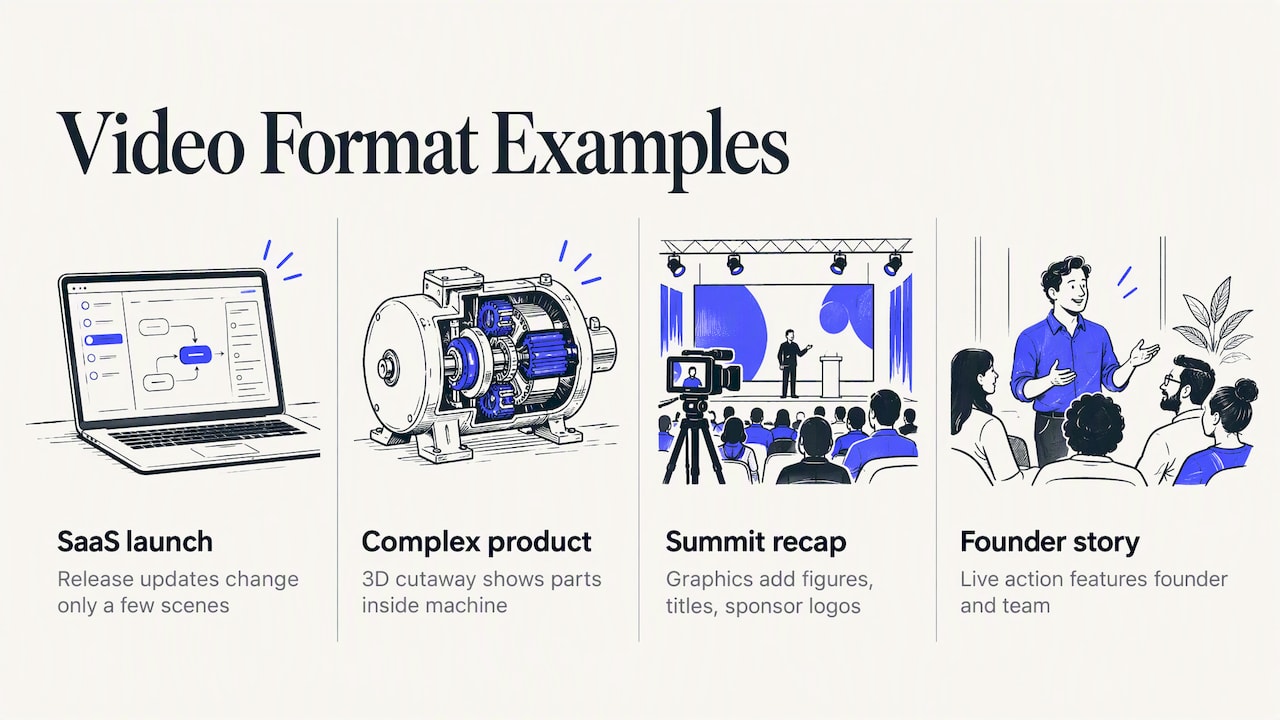
A SaaS company launching a feature. The audience needs to understand a workflow. A 2D motion graphics explainer with screen recordings and animated callouts is the practical choice. Updates for the next release mean changing a few scenes, not rebuilding the video.
A manufacturer with a complex product. Buyers need to see how parts interact inside a machine. A 3D animation shows the cutaway view that no camera can capture, and it can be reused at trade shows and in sales decks.
A conference organizer wrapping up a summit. The sponsor recap needs real speakers and crowd energy, so live action leads. Motion graphics supply attendance figures, session titles and sponsor logos. The same footage then becomes short social clips, which is the idea behind repurposing event footage for growth.
A founder-led brand with a values story. The strongest asset is the founder and the team, so live action carries it. A short animated sequence can illustrate the origin story or a customer journey. See our overview of brand story video production for how that works.
Our perspective: start from the business outcome, not the technique
Clients often arrive asking for “an animation” or “some motion graphics” when what they really need is a result: more qualified leads, a clearer sales conversation, a stronger event follow-up. We work backward from that result. The technique is a tool, and the right one depends on the audience and where the video will live.
In our experience the most common mistake is picking the technique by looks alone. A beautiful 3D piece that takes months to produce is the wrong answer for a message that will change next quarter. A quick text-and-icon explainer is the wrong answer for a brand that needs warmth and character. We would rather tell you that before the shoot or the storyboard than after.
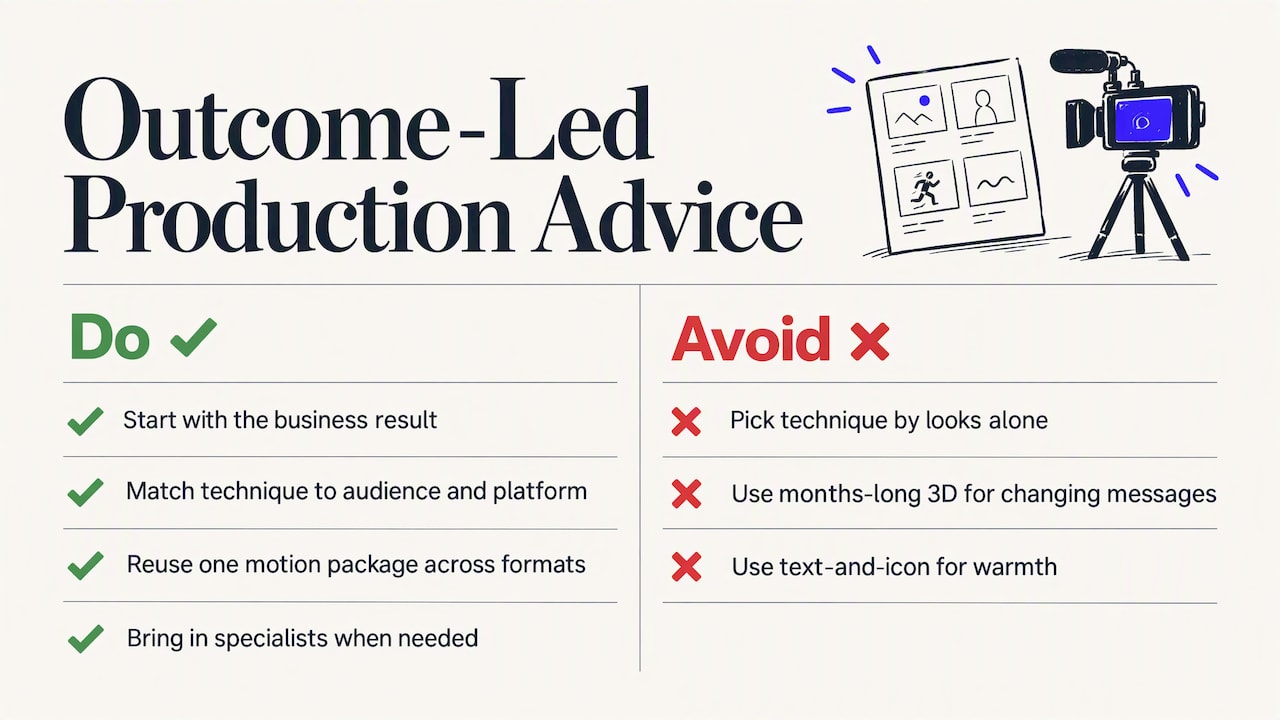
We also encourage teams to think in systems. Build one motion graphics package from your brand guidelines, then use it across live-action interviews, event recaps, ad creatives and social cutdowns. The consistency makes your content recognizable, and every new video costs less to produce than the last. That is the thinking behind creative automation that protects brand quality.
Finally, we bring in specialists when the project calls for them. Our nationwide network of professionals means a live-action crew in one city, an animator or motion designer elsewhere, and a single point of contact for your team.
— Brandon V
What about AI and hiring?
Teams ask whether AI will replace motion designers. The current evidence points to augmentation. Tools such as Adobe Firefly are being used for rapid prototyping and background assets, while creative direction stays human-led. For a business buyer that means faster drafts and more options, but you still need someone who understands your brand, your audience and your edit.
On the staffing side, the U.S. Bureau of Labor Statistics groups animators and related artists in its arts and design occupations, and the field leans heavily toward freelance work. That is why many companies hire through a production partner who can assemble and manage the right team rather than coordinating individual freelancers.
Briefing your production partner
A clear brief saves revisions. Include:
- The goal and the audience. One sentence each.
- Where it will run. Website, social, trade show screen, sales deck, event stage.
- Length and versions. One hero video plus cutdowns, with aspect ratios (16:9, 9:16, 1:1).
- Existing assets. Brand guidelines, logo files, footage, scripts, product renders.
- Update plan. What will change, and how often.
- Approvals. Who signs off, and at which stage (script, storyboard, animatic, final).
If you want to see how campaigns come together around a goal, our collection of B2B video campaign examples is a good place to start.
Work with V2 Visuals
V2 Visuals produces video and photography for brands, businesses and events, including motion graphics, animated video, corporate and marketing video, ad creative and video editing. Every project starts with your goals and is measured against business outcomes. If you are weighing motion graphics, animation and live action for an upcoming launch or event, talk to us about video production and we will recommend the mix that fits your goal and budget.
FAQ
Is motion graphics a type of animation?
Yes. Motion graphics are a form of animation focused on moving graphic elements such as type, shapes and icons. The difference is purpose: motion graphics usually inform or brand, while story animation usually builds a narrative with characters.
Which is cheaper, motion graphics or animation?
Motion graphics are usually the lighter, faster option because they rely on simpler design systems and reusable assets. Custom character animation, and 3D especially, involves more stages and unique assets. Final cost depends on length, style and revisions, so request a quote based on a written brief.
Should I choose 2D or 3D animation for a business video?
Choose 2D for explaining services, workflows and abstract ideas, particularly on tighter timelines. Choose 3D when you need depth, such as showing a product, space or machine from several angles. If you are unsure, a short storyboard test of both approaches can settle it.
Is live action better than animation for marketing?
Neither is better by default. Live action is strongest for trust, people and real places, while animation is strongest for abstract ideas and things that cannot be filmed. Many effective videos combine live-action footage with animated graphics.
Will AI replace motion graphics designers?
Current evidence suggests AI is speeding up prototyping and asset creation rather than replacing designers. Creative direction and brand judgment remain human tasks, so businesses still benefit from an experienced creative team.
Sources
- Motion Graphics vs Animation: Key Differences & Hiring Guide
- Your next career move: motion graphics vs. animation
- What Is Motion Graphics? A Complete Guide, Adobe
- What Does a Motion Graphics Designer Do?, Coursera
- 3D Animation: The Ultimate Animation Guide, Autodesk
- Live action, Wikipedia
- Three main differences between animated and live-action video
- Arts and Design Occupations, U.S. Bureau of Labor Statistics