



Most promo videos work best between 15 and 60 seconds. Use 15 to 30 seconds for social feeds and paid ads, and up to 60 seconds on your own website, where viewers chose to watch. Go longer only when the job is to explain, educate or nurture, and then think in minutes, not seconds. The right number depends on your goal, your channel and how many ideas the video has to carry.
This guide gives you target lengths by goal, platform and video type, covers the testimonial and explainer questions marketers ask most, and ends with a short process for locking the runtime before production starts.
TL;DR
- Brand awareness and social promos: stay under 60 seconds. Paid awareness placements often run 6 to 30 seconds.
- Your own website and landing pages: 30 to 90 seconds suits a promo, and 1 to 5 minutes suits an explainer.
- Testimonials: aim for roughly 60 to 120 seconds, shorter for ads, longer for case-study pages.
- Decide the length before scripting. Runtime sets how many scenes and messages you can fit.
- After launch, use retention reports to find where viewers leave, rather than relying on industry averages.
Table of Contents
- The short answer: match length to the goal
- Promo video length by platform
- Promo video length by video type
- How long should a testimonial video be?
- Why runtime is a production decision, not just a marketing one
- How to choose your promo video length: a five-step process
- Measure, then adjust
- Our perspective: length follows the business goal
- Plan your promo with V2 Visuals
- FAQ
- Sources
The short answer: match length to the goal
There is no universal ideal length. A Wistia breakdown of video length by marketing goal groups runtimes by what the video is meant to do, and that is the most useful way to think about it.
| Goal | Typical length | Common formats |
|---|---|---|
| Awareness and social engagement | Under 1 minute | Promos, teasers, brand clips |
| Educate or explain | 1 to 5 minutes | How-tos, explainers, product tours |
| Convert or nurture | 5 to 30 minutes | Webinars, walkthroughs, case studies |
The same source reports that, in its 2025 data, videos under one minute averaged a 52% engagement rate, while videos of 5 to 30 minutes averaged a 9% click-through rate. It also reports an 11% drop in engagement once videos pass 30 minutes. Those figures describe different jobs, not a ranking. A short video is not better than a long one. It is better at a different task.
A broader rule of thumb comes from Promo.com’s video length guidance: most online videos land between 30 seconds and 4 minutes, and the longer a video runs, the more likely viewers are to drop off. Keep the video as short as the goal allows, and as long as the message truly needs.
Promo video length by platform
Platform behavior matters as much as goal. Viewers in a feed are scrolling. Viewers on your homepage already showed interest. Those two audiences tolerate very different runtimes.
Social feeds and in-feed ads
For social feeds and ads, OneCraft recommends 15 to 30 seconds, and under 60 seconds on your own website. Google’s documentation points the same way for short-form: YouTube Shorts and in-feed placements perform best under 60 seconds, according to the research behind this guide. Put your core message in the first few seconds, because that is when a viewer decides whether to stay.
YouTube in-stream ads
Google Ads publishes the formats for non-skippable in-stream ads. Bumper ads run 6 seconds, standard non-skippable ads run 7 to 15 seconds, and 16 to 30 seconds applies to Connected TV. If you are building an awareness campaign, plan a family of cutdowns: a 6-second bumper, a 15-second spot and a 30-second version, all cut from the same shoot.
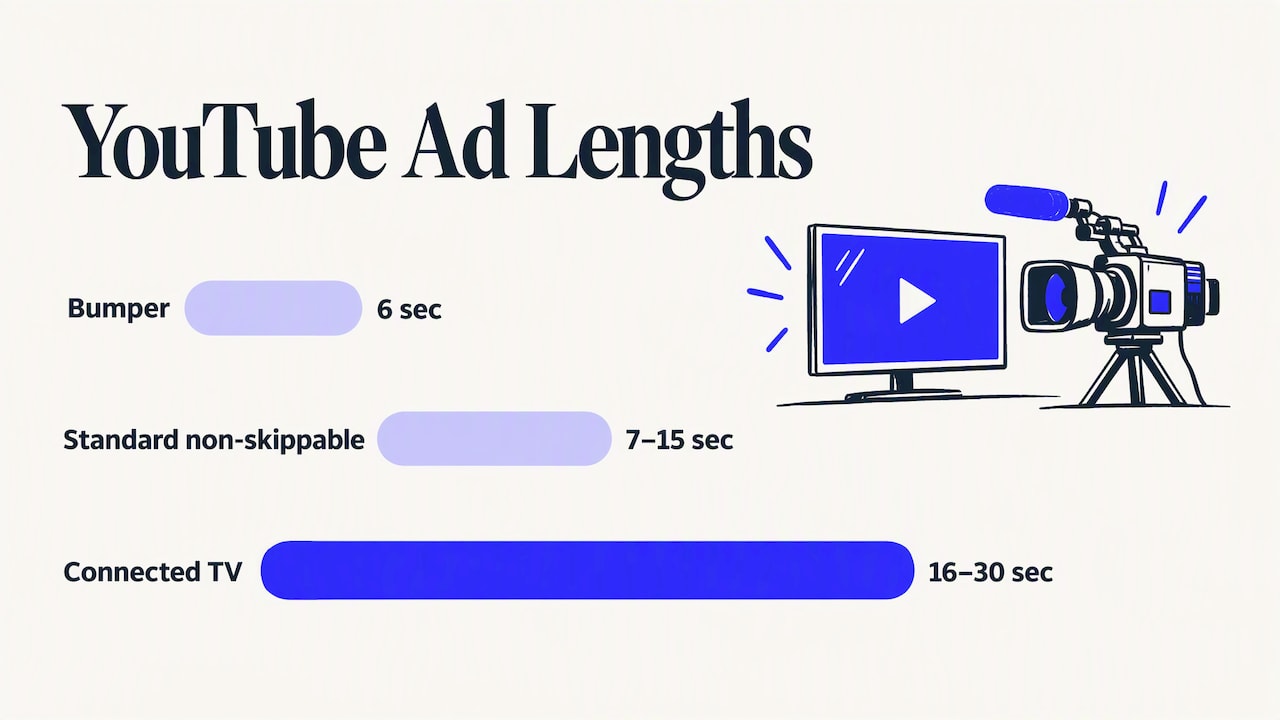
Precision matters on TV placements. For YouTube TV, Google states that 30-second and 60-second ads must match the required length within a 1-second tolerance, so a 30-second ad must fall between 29 and 31 seconds or it will not serve. Confirm the technical specs before the edit is locked.
LinkedIn and B2B placements
B2B audiences watch on LinkedIn between meetings, often at a desk, and they will give a clear, relevant message a little more time than a consumer feed would. A 30 to 60 second cut works well for most B2B promos, with thought leadership and product demos stretching to a couple of minutes. We go deeper on this in our guide to LinkedIn video ad creative.
Your website and landing pages
Visitors on your homepage or a product page chose to be there. A 30 to 90 second promo gives them the story without making them hunt for the point. Place the video high on the page, make the first five seconds carry the value proposition, and add captions so it works with sound off.
YouTube channel and organic video
On YouTube itself, the picture is more varied. HubSpot reports that on its own channel, its audience engages most with videos just under two minutes, so the team aims for around 120 seconds. That is one brand’s audience, not a rule, but it is a useful starting point when you have no data of your own.
Promo video length by video type
When clients ask how long a promo should be, the real question is often which kind of video they need. Here are working ranges, based on the sources above and on how these formats are typically built.
- Brand awareness spot: 6 to 30 seconds. One idea, one feeling, one call to action.
- Product or service promo: 30 to 60 seconds. Enough room for a problem, a solution and a proof point.
- Brand story film: 1 to 3 minutes. This is where emotion and narrative earn the extra time. See our overview of brand story video production.
- Explainer video: 1 to 3 minutes for most products. Wistia puts the educate-or-explain range at 1 to 5 minutes, and the longer end suits complex software or multi-step services.
- Event recap or highlight reel: 60 to 90 seconds for the promo cut, with a longer recap kept for your site.
- Recruitment video: 60 to 120 seconds, long enough to show culture and roles. Our page on recruitment video production covers the approach.
- Case study or webinar: 5 to 30 minutes, for viewers who are already evaluating you.
If you are choosing between formats, our guide to the best corporate video formats shows where each one fits in a campaign.
How long should a testimonial video be?
A testimonial has a different job from a promo. It is proof, and proof works when it feels real and specific. Most testimonial videos work well between 60 and 120 seconds. That is a production guideline from our experience of how these stories are structured, not a measured industry statistic.
Three practical rules help:
- Cut for ads, keep for pages. Make a 30 to 45 second version for paid social and a 90 to 120 second version for your testimonial or case study page.
- Lead with the result. Open on the outcome the customer got, then show how they got there.
- Cut the backstory. One sentence of context is usually enough. Viewers want the problem, the change and the result.
A longer case study, such as a five-minute walkthrough with the customer and your team, belongs in the nurture stage, where the 5 to 30 minute range applies.
On testimonial video cost: it depends on the number of interviews, locations, crew size and edit versions, so we do not publish a flat price. If you are budgeting, start with the length and the number of cutdowns you need, then request a quote. Our page on customer testimonial video production explains how we plan these shoots.
Why runtime is a production decision, not just a marketing one
Length is not a slider you adjust at the end. It is a budget for scenes. OneCraft’s guidance notes that a 30-second video generally holds 6 to 12 scenes, while a 10-second spot holds 3 to 6. Cram a complex story into too short a runtime and the pacing feels rushed, the viewer cannot absorb the visuals or the message, and the production budget is wasted.
That is why we set the runtime before the script. A quick test:
- List every message the video must land. If you have more than two for a 30-second spot, cut messages or raise the runtime.
- Count the locations, interviews and product shots you need. Each needs screen time.
- Decide which cutdowns you need now, so the shoot captures enough coverage for 6, 15, 30 and 60 second versions.
Planning cutdowns at the start is cheaper than trying to reverse-engineer them from one long edit later.
How to choose your promo video length: a five-step process
- Name the funnel stage. Awareness, consideration or conversion. Awareness content is short and focused on a single message, while consideration and conversion content needs more depth to build trust and explain value.
- List the channels. Each placement has its own sweet spot and technical limits. Write them down before you write the script.
- Set the message count. One idea for 6 to 15 seconds, two or three for 30 to 60 seconds, a short narrative arc for 90 seconds or more.
- Design the first five seconds. Put the hook and value proposition up front, and add captions so the video works without sound.
- Plan the cutdowns. Shoot once, edit a hero version and several shorter versions for ads and social.
Measure, then adjust
Averages are a starting point. Your audience may behave differently. vidIQ advises against relying on average view duration alone and recommends using audience retention reports to see where viewers drop off, skip or re-watch. If most viewers leave at the 20-second mark of a 60-second video, you may have a pacing problem rather than a length problem.
Track what happens after the view as well. Engagement is only useful if it leads somewhere, and a framework for content effectiveness metrics can help connect viewing behavior to pipeline and revenue. Our own approach to this is covered in how to improve video marketing ROI.
For awareness campaigns in particular, the goal is to stop the scroll, and short-form promotional videos are designed for exactly that. Test two or three versions and let the data pick the winner.
Our perspective: length follows the business goal
We start every project by asking what the video needs to do for the business, and how the viewer will find it. A promo that is gorgeous but runs 90 seconds in a placement that rewards 15 will underperform. A 15-second cut that tries to tell a founder story will feel thin.
Our process is built around return on investment. We filter creative decisions, including runtime, through the outcome you want: leads, bookings, event registrations or hires. That is why we plan the master edit and the cutdowns together, and why we shoot enough coverage that your team is not locked into a single length.
Two habits we recommend to every marketing team. First, decide the primary channel before the shoot, not after. Second, treat the first draft’s length as a hypothesis. Look at the retention curve, and be willing to re-cut.
— Brandon V
Plan your promo with V2 Visuals
If you want a promo, testimonial or explainer built around the right runtime for each channel, our team handles strategy, production and editing across the United States. Explore our video production services, or if your video supports a conference or launch, see our corporate event videography. To talk through your project, start at v2visuals.com.
FAQ
How long should a promo video be?
For most businesses, 15 to 60 seconds. Use 15 to 30 seconds for social feeds and ads, and up to 60 seconds on your website. If the video must explain a complex product, extend it to 1 to 3 minutes and treat it as an explainer.
What is the ideal explainer video length?
Wistia’s guidance places explaining and educating content in the 1 to 5 minute range. For most products, 60 to 120 seconds is enough to cover the problem, the solution and the next step. Add time only if the product genuinely needs it.
How long should a testimonial video be?
Aim for 60 to 120 seconds on a page and 30 to 45 seconds for paid social. Open with the result and cut unnecessary backstory. A longer case study can run several minutes for viewers who are already comparing vendors.
Is a 3 minute video too long for LinkedIn?
Not necessarily, but it is long for a promo. A 3-minute video can work for thought leadership or a product demo to an audience that already follows you. For cold paid reach, a 30 to 60 second version usually makes more sense.
Sources
- How to Choose the Right Marketing Video Length for Any Goal, Wistia
- How Long Should a Promo Video Be? Lengths by Platform, OneCraft
- Non-skippable in-stream ads, Google Ads Help
- About YouTube TV ad formats, Google Ads Help
- How to Find the Best YouTube Video Length, vidIQ
- Video length best practices, Promo.com
- How Long Should Your Videos Be?, HubSpot