



The best testimonial videos share one trait: a real customer explains a specific problem, what changed, and what it was worth, in their own words and in under two minutes. The examples below show that pattern in B2B, e-commerce and service businesses, and the sections after them give you the interview questions, script structure and formats to build your own. If you want a team that plans the story around the business outcome you need, our customer testimonial video production work is built on exactly that approach.
TL;DR
- Strong testimonials open with the customer’s problem or result, not a logo and a compliment.
- Specifics persuade: a named role, a before-and-after, a number the customer says themselves.
- Ask open-ended questions, one at a time, and edit to roughly 90 to 150 seconds for the main cut.
- One interview can become a full cut, a short teaser and clips for sales and social.
- US endorsement rules require honest opinions and real customers, so get approvals in writing before you shoot.
Table of Contents
- What separates a testimonial video from a compliment on camera
- Testimonial video examples worth studying
- Customer testimonial questions that produce a usable story
- How to turn answers into a natural testimonial video script
- Testimonial video ideas and formats for different goals
- Getting testimonials right under US rules
- Where we come in
- Our perspective on testimonial video
- FAQ
- Sources
What separates a testimonial video from a compliment on camera
A written quote says someone liked you. A video lets a buyer watch a person like themselves describe a decision, hear the hesitation in their voice and see the product or service in their world. That is why marketing teams, event organizers and sales leaders keep asking for them.
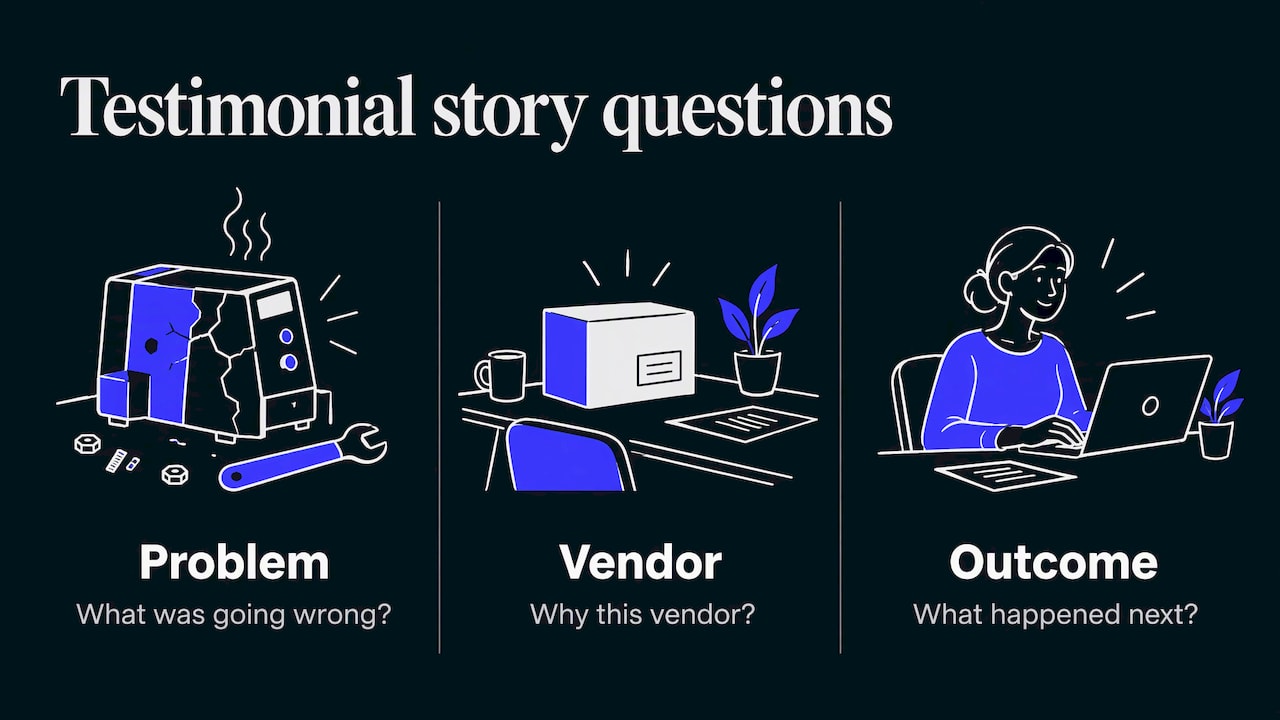
But the format punishes vague content. A customer saying “they were great to work with” tells a prospect nothing they could not guess. The examples that get shared inside buying committees answer three questions: what was going wrong, why this vendor, and what happened next. Keep those three in mind as you read the examples.
Testimonial video examples worth studying
The examples below come from published guides and brand channels. Each one is useful for a different technique, so borrow the technique, not the look.
Short and focused: the Handled. testimonial for HubSpot
HubSpot’s own roundup of testimonial videos singles out the Handled. testimonial as a model because it stays short and focused. It shows more than the software’s power: it conveys how the customer feels about the HubSpot team’s investment in their success. The lesson is that emotion about the relationship can carry a B2B story when the runtime is tight.
Measurable impact: ClassPass on analytics
The same HubSpot guide features ClassPass discussing how HubSpot helped manage and gather analytics, with a measurable impact. This is the format for buyers who need to justify a purchase to finance. The customer names the problem (scattered data), the change and the result, so a prospect can repeat it to their own boss.
Casual and self-shot: small-business owners in UGC style
Shopify’s guide collects UGC-style testimonial examples: a candle maker talking casually about getting time back from packaging, cabin-resort owners showing firepits in use, a graphic designer filming himself at his workstation, and a taqueria owner explaining how canning cocktails added revenue. None of them look like ads. Their value is that the viewer sees a peer, in a real setting, using the product.
This style suits direct-to-consumer and small-business audiences. For corporate buyers, the equivalent is a customer in their actual office or facility rather than a blank studio backdrop.
Results-first case-study documentaries
Longer story-led projects can be framed around outcomes from the first scene. For one example of a story-led video project reported in results terms, see this documentary launch case study. Notice how the headline is the business result, which is the same instinct you want in the first ten seconds of a testimonial.
What the strongest examples have in common
- A specific opening. The first lines state the problem or the outcome.
- A real role and company on screen. Name and title overlays make the speaker verifiable.
- Visuals that prove the words. The product in use, the dashboard, the finished installation or the event floor.
- One idea per video. Cost savings, speed, trust or ease of rollout, not all four.
- The customer’s own phrasing. Scripted-sounding praise reads as a hostage statement; slightly imperfect answers read as true.
We cover related formats in our guide to B2B video campaign examples, which is a good next read if testimonials are one piece of a larger demand plan.
Customer testimonial questions that produce a usable story
The interview is where a testimonial is won or lost. Yes-or-no questions get yes-or-no answers. Ask prompts that invite a story.
MarketingProfs recommends sending a questionnaire ahead of shoot day with questions such as what issue the customer wanted to solve, how the product improved their business, and whether they would recommend it and why. SproutVideo suggests prompts like “Take me back to the moment you realized you needed help” and asking what would have happened if they had not found the product.
A working question set, in the order you would ask it:
- Tell us who you are and what your team is responsible for.
- What was happening before you started looking for a solution?
- What had you tried, and why did it fall short?
- What made you choose this company?
- Was there anything that worried you before you started?
- What did the first few weeks look like?
- What has changed since, in numbers or in day-to-day work?
- What would you say to someone in your position who is still deciding?
Two practical rules. Ask one question at a time and let the customer finish, because the best sentence often arrives after a pause. And ask for the number in the customer’s voice: “How many hours a week did that take before?” lands harder than a statistic added in a graphic.
How to turn answers into a natural testimonial video script
A testimonial is rarely scripted word for word. You are writing a structure, then editing the customer’s real answers into it. A reliable shape:
- Hook (first 10 seconds). The most striking sentence from the interview, such as the result or the frustration. SproutVideo notes that viewers decide within about ten seconds whether to keep watching, so do not spend them on a logo animation.
- Introduction. Name, role, company, one line on what they do.
- The problem. What was going wrong and what it cost them.
- The decision and solution. Why they chose you and what the work looked like.
- The result. A before-and-after, with proof on screen where possible.
- The recommendation. One closing line in the customer’s words.
MarketingProfs advises editing the final video to 90 to 150 seconds, with close-ups for emotional quotes, name and title overlays, and your brand colors and logo. Treat that as the length of the main cut, then build shorter versions of 15 to 30 seconds for social and ads.
Keeping it authentic
Authenticity is mostly about what you leave in. Keep the hesitation, the honest “we were nervous about rollout” and the customer’s own vocabulary. Film in their workplace so the setting corroborates the story. Let them see the questions beforehand but not rehearsed answers.
If you are planning a shoot in Southern California, our walkthrough on planning a testimonial shoot in Los Angeles covers location, lighting and interview setup in more detail.
Testimonial video ideas and formats for different goals
Not every customer story needs a three-minute interview. Match the format to the job it has to do:
| Format | Typical length | Best used for |
|---|---|---|
| Short testimonial | 30 to 90 seconds | Home page, landing pages, email to warm leads |
| Case-study video | 2 to 5 minutes | Late-stage sales conversations, proposals |
| Teaser clip | 15 to 30 seconds | Paid social, retargeting, event signage |
| Event testimonial | 30 to 60 seconds | Attendee or sponsor reactions captured on site |
| Before-and-after | 30 seconds to a few minutes | Services where the transformation is visible |
| Animated customer story | 60 to 90 seconds | Customers who cannot be filmed, with voiceover and screenshots |
The lengths are working ranges rather than rules. The idea that matters is the library: record one thorough interview and cut it into a complete story, clips that answer common objections, role-specific versions for finance, IT or operations, and a written case study for the website. Our guide to corporate video types shows where testimonials sit among the other formats a company usually needs.
Event organizers have a particular advantage here. Attendees, speakers and sponsors are all in one place, so a few well-run on-camera conversations during the event can become next year’s sales material.
Getting testimonials right under US rules
A testimonial is an advertisement, so US advertising rules apply. The FTC’s Endorsement Guides state that endorsements must reflect the endorser’s honest opinions, findings, beliefs or experience, that someone presented as a user must have been a genuine user when they gave the endorsement, and that advertisers can be liable for not disclosing unexpected material connections, such as payment or free services.
In practice:
- Feature only real customers speaking about real experience.
- Disclose any compensation or relationship that viewers would not expect.
- Do not edit a customer’s words into a claim they did not make, and do not turn “it feels faster” into a percentage.
- Agree in writing where the video will run (website, paid ads, events), for how long, and who approves the final cut.
For legal questions about a specific campaign, check with your company’s counsel before publishing.
Where we come in
We produce corporate, marketing and branding video, event videography and photography for businesses, marketing teams and event organizers, with a nationwide network of professionals. For testimonials that means starting from your goal, whether that is leads, shorter sales cycles or event sponsorship, and shaping the questions, setting and edit around it. You can see the full range on our video production page, or start from our testimonial video production service.

If your next customer story is also part of an event, our crews can capture it alongside your coverage, so the testimonial and the event footage share one plan.
Our perspective on testimonial video
We start every testimonial project by asking what the video has to do for the business, because the answer decides who we interview, what we ask and how we cut it.
A testimonial that is meant to shorten the sales cycle looks different from one meant to fill an event sponsor pipeline. Our approach emphasizes return on investment, so we want the customer’s story to translate into leads and growth, not only into a nice-looking piece.
We also think the best testimonials are planned as a set. One good interview should give you a hero video, short cuts for ads and social, and clips your sales team can send to a specific buyer. Planning that before the shoot is what keeps the cost per usable asset low.
Brandon V
FAQ
What makes a good testimonial video?
A good testimonial features a real customer with a clear role, describes a specific problem and result, and is short enough to hold attention. Visuals that show the product or work in use make the claims believable.
How long should a customer testimonial video be?
For the main cut, aim for roughly 90 to 150 seconds, a range MarketingProfs recommends. Make 15 to 30 second versions for social and ads, and a longer case-study cut when a deal needs more detail.
Is a video testimonial better than a written one?
Video shows the person, their tone and the setting, which makes the story easier to trust and remember. Many teams pair the two, putting a pulled quote under the video on the page.
How many questions should I ask a customer?
Six to eight open-ended questions are enough for a full interview, asked one at a time. You will usually use only a few answers in the final edit, so prioritize the problem, the decision and the result.
Do I need written permission from the customer?
Yes. Agree in writing where the video will appear, how long it can run and who approves the final edit. Endorsements must also reflect the customer’s honest experience under the FTC’s guides.
Sources
- HubSpot: Testimonial Videos, 10 Powerful Examples
- Shopify: How To Create Testimonial Videos
- eCFR: 16 CFR Part 255, Guides Concerning Use of Endorsements and Testimonials
- MarketingProfs: How to Make a Testimonial Video
- SproutVideo: Step-by-Step Guide to Creating a Customer Story Video